
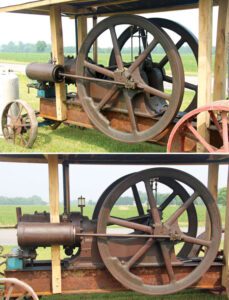
Glen Yoder’s extensive collection includes 100-year-old antique engines. Among his rare assemblage is a Reid oil field engine and a Fairbanks-Morse hit-and-miss engine made for the Mexican market.
Glen’s interest in mechanical things, including engines, can be traced to past experiences. “Like most kids with farm interests, I had all kinds of scale model tractors. My family helped Grandpa with his farming operation. And so, I was hauling hay with Grandpa’s Ford Model 8N tractor when I was 10 years old,” Glen says.
He continues, “Whenever possible, our family attended antique tractor shows. Through that early farm work and those shows, I started collecting antique engines. At age 13, I was drawn to a David Bradley garden tractor that I bought. I was excited to learn more about engines and how they worked. That interest grew to where I currently have several vintage tractors and numerous hit-and-miss engines. As time allows, I restore them to run like new.”
Reid oil field engine
While attending the Tri State Antique Gas Engine & Tractor Show in Portland, Indiana, a few years ago, Glen acquired the Reid oil field engine. “The 1917 Type A Reid engine wasn’t running and it was in rough shape. The price was right, so I bought it. I knew the Reids were different than most oil field engines. It was a challenge to learn about the engine and then, get it up and running,” he says.
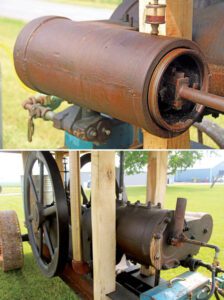
Glen described the required restoration. “I first replaced the valve that opens and closes between the pre-combustion piston chamber and the main power cylinder. New plumbing and oilers were installed. And then, the piston pin bearings were changed out.
“The biggest challenge was finding a replacement for the main crankshaft bearing. I measured the bearing to determine its size. It so happened that I had a crankshaft bearing from a John Deere Model D tractor laying aside that was the correct size. When the bearing was installed, it worked perfectly,” he adds.
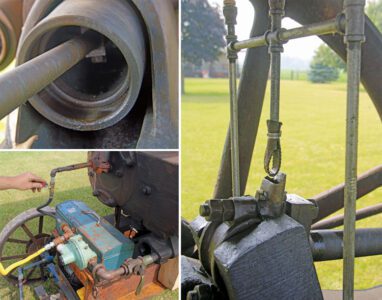
Glen also built the transport cart, including the steel I-beams for support. The axles and wheels came off an International Model 1020 tractor. He then added the wood framework to support the metal cover.
Reid engine history and operation
Joseph Reid, who immigrated from Scotland in 1862, had worked in the railroad industry. By 1876, he established the Joseph Reid Gas Engine Co. located in Oil City, Pennsylvania. Reid developed his first gas engine for pumping oil wells in 1894.
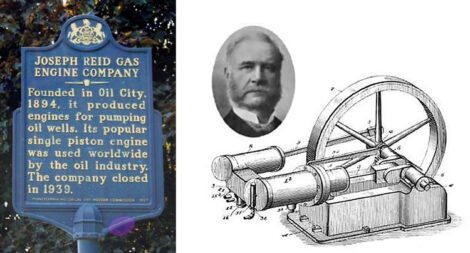
The Reid engine relied on natural gas from the oil well for its power. The engines used a separate charging cylinder located on the outside to compress the fuel/air mixture. The natural gas mixture then ignites the combustion.
The many different types and styles of Reid engines included 2- and 4-cycles. They are referenced with a letter designation. The Type A engine was rated at 15hp, whereas the Type C could turn 55hp. The type DC engines have a 13-1/4-by-18-inch bore and stroke and are powered by gas or diesel. The gas engines are rated at 63hp (at 180rpm) to 100hp (at 300rpm). The diesel engines are rated at 60hp (at 200rpm) to 90hp (at 300rpm).
The popular single-cylinder engine was used worldwide in the oil industry. The firm’s success continued until about 1948 when smaller and more efficient engines came on the market.
Fairbanks-Morse engine
Glen acquired the Fairbanks-Morse hit-and-miss engine by chance. He explains, “A friend traveled to Mexico for the purpose of gathering up some rare engines. Among them was a Fairbanks-Morse Model Z hit-and-miss engine. The engine stood along a river for several years after a job was done. As a result, it was a ‘basket case.’ I like the challenge of restoring old engines, so I bought it. We know it was made in Mexico as the engraved inscriptions are entirely in Spanish.
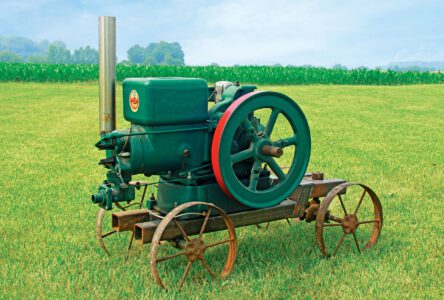
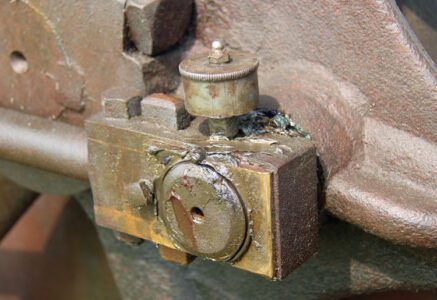
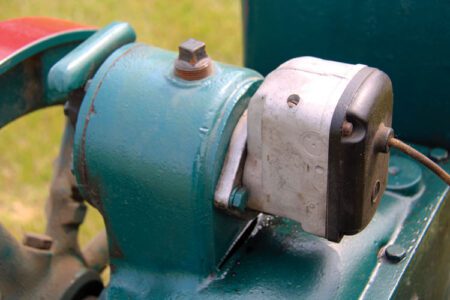
“With this engine, I took it down to the castings and started over. It required a new main bearing, rings, and valves. I rebuilt the magneto and replaced all the gaskets. Locating parts to rebuild the carburetor was the biggest task. It took nearly a year before I had all the needed parts,” he adds.
When the engine was ready for assembly, Glen applied powder coating for a finished look. He also built the cart from scrap metal and made it mobile with wheels he found around his property.
Fairbanks-Morse history
The storied history of Fairbanks-Morse is longer than space allows in this article. However, an abbreviated review of this topic follows.
Thaddeus Fairbanks launched an ironworks business in St. Johnsbury, Vermont, in 1823. Originally the firm manufactured weighing scales. It would later move into pumps, engines, windmills, coffee grinders, radios, farm tractors, feed mills, locomotives and industrial supplies.
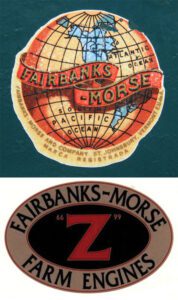
As for Morse in the company name, back in 1853, Charles Hosmer Morse completed a 3-year apprenticeship in the Boston office of E&T Fairbanks & Co. Three years later, Morse became a partner in the Chicago firm of Fairbanks, Greenleaf & Co. Greenleaf died the following year and Morse carried on the business independently. He did so under the name of Fairbanks, Morse & Co.
The Fairbanks Morse Co. began producing oil and gas engines in the 1890s by purchasing the Charter engine line. The Charter line featured the first commercially available gas engines. For its versatility, the small hit-and-miss engine became a success with farmers.
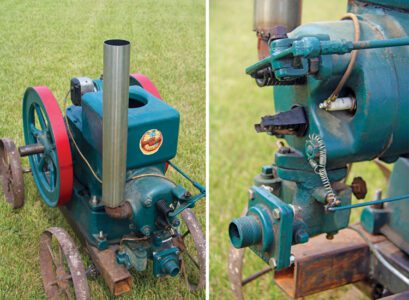
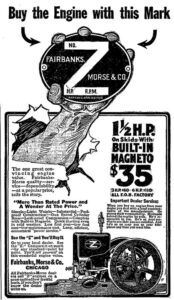
In 1914, the company renamed its headless 1.5hp engine as the Model Z, according to engine historian C.H. Wendel. The gas tank for the Model Z is located in the base. By 1918, the company discontinued making headless models and adapted the 1.5hp to have a head. This allowed larger engines to run on kerosene.
The Model Z engines were made as 3, 6, 12, 15, and up to 20 horsepower. With these range of models, over a half million engines were produced over a period of 30 years. A factory was opened in Toluca De Lerdo, Mexico, for the production of the Model Z engine. From the Mexico factory, Model Z engines were built into the 1980s.
Through mergers and acquisitions, Fairbanks, Morse & Co. would assume different names. EnPro Industries Inc. eventually became the parent company of Fairbanks-Morse until Jan. 21, 2020, when Areline Investment Management became the owners.
Collector profile
Glen Yoder was born in Hicksville, Ohio, but his parents located their family to Nappanee, Indiana, where he lived most of his life. In 2015, Glen and his wife, Carrie, resettled their family to Plymouth, Indiana.
Glen helped on his grandfather’s 120-acre farm. “I loved operating Grandpa’s tractors. They included a Farmall Model M and Model 560, a John Deere Model 70, and a Ford Model 8N. “I still have the old Deere Model 70,” he says.
Glen’s extensive antique engine collection dates back to his teen years. He comments, “I got Grandpa’s John Deere Model 70 when I was 18. And then at age 20, I bought my first hit-and-miss engine. My collection currently includes nine tractors and 25 hit-and-miss engines.
“My wife and I have four children, three sons and one daughter. The two oldest boys like helping in the shop when we’re restoring engines. Their collection consists of four antique tractors. Like years past, our family enjoys attending antique tractor shows,” Glen adds.
By the time this story is published, Glen and his sons will have restored a 1935 John Deere Model GP Beaner. The John Deere Beaner was built to cultivate four, 28-inch rows of soybeans. The model differs, having a wide axle and tie-rods located behind the axle. It also has different style rear wheels. “Based on my research, there were only 120 built. That makes my 1935 Beaner a very rare tractor,” he says.
Glen reflected on his pastime/hobby. “I like the challenge of buying a tractor or engine that is stuck and won’t run. Working with my sons in getting it running provides great satisfaction. As for the hobby, we’ve come in contact with a lot of good people. We have been blessed through it all,” Glen concludes.
For for anyone who would like to learn more about Glen Yoder’s antique engines, he welcomes your call: 574.935.3838. Freelance writer Fred Hendricks of Mansfield, Ohio, covers a vast array of subjects relating to agriculture. You may email Fred at fwhendricks@gmail.com