The massive gas engine book put out by Charles Wendel in 1983, known to collectors simply as the Big Yellow Book (BYB), has always been a sort of wish book. Much like with the Christmas catalogs of years past put out by Sears, Montgomery Ward, and J.C. Penney, I’ve spent countless hours perusing the BYB for engines of interest that I wished someday to find and maybe buy.
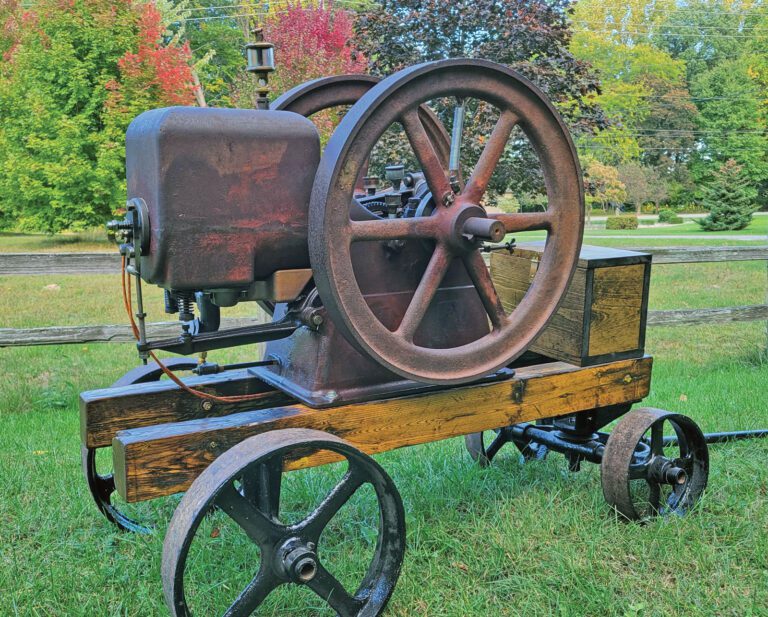
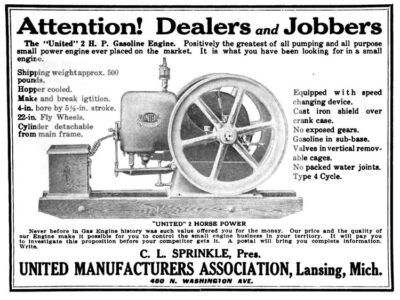
One such engine was all the way in the back, in the listing for United Engine Co. of Lansing, Michigan. One of the early offerings from the company, it was labelled as the Type B, rated at 2hp, with a bore of 4 inches and stroke of 5-1/2 inches. The engine was a headless design with a long rocker arm under the cylinder to activate the exhaust valve and ignitor. The unique design of the engine made it attractive to me, and I committed it to memory – maybe someday I’d see one for sale.
Finding the elusive United Type B
The United Type B isn’t a common engine, and finding one would require patience and luck. I saw one at the Waukee, Iowa, swap meet in the 1980s, already sold. Another appeared in the mid-1990s at an auction in Ohio, but I was chasing other targets. It’d be 20-plus years until I encountered another, in a collection in Michigan, which, of course, wasn’t for sale.
Talking with a friend from Ohio, Gary Stoner, I learned that he also had one in his collection. It was a project engine, in need of parts. Gary said another engine was with Walt Saylor, and the two of them were working together to complete the engines. As the work on the engines was ongoing, they weren’t interested in parting with them.
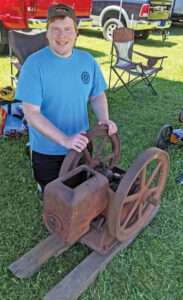
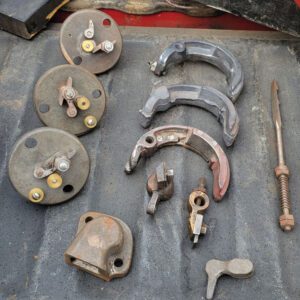
A post by Mike O’Malley of Massachusetts on Facebook in the spring of 2021 showed a large collection of engines that he’d recently purchased. The collection was from the eastern end of Long Island, New York, about 150 miles from Mike’s house, requiring a ferry ride to retrieve them. Many of the engines were in parts, with pieces scattered everywhere, both inside and out. Mike posted several pictures of his loads. An engine on the corner of his trailer caught my eye, a United Type B.
I contacted Mike and inquired about the engine. He said it appeared to be stuck and missing many parts, including the ignitor and trip, carb, and governor. Still, I was interested. He said he had others interested, and I was third in line. I asked him to contact me if my number came up, but I was not at all optimistic.
Surprisingly, Mike contacted me the next day, saying that the United Type B was available if I still wanted it. We made the deal. Mike was still hauling stuff out of Long Island, and pledged to look for the missing pieces, but, ultimately, none were found. Mike would deliver the engine to us at the Coolspring Engine Show in June.
Manufacturer of the Type B
The United Engine Co. wasn’t a manufacturer. They put their nameplate on engines that were made by other companies. The first engine offering from United came in 1911, and was made by J. Thompson & Son of Beloit, Wisconsin. Other manufacturers that sourced to United included Nelson Bros. Co. of Saginaw, Michigan; Waterloo Gas Engine Co. of Waterloo, Iowa; and Associated Manufacturers Co. of Waterloo, Iowa. Associated-made United engines were sold in the thousands, and are the most common surviving today.
The Type B was the second style of engine offered by United. Ads for the Type B appeared in trade magazines from September 1911 through February 1912. Ads for United engines made by Waterloo Gas Engine Co. first appeared in November 1911, overlapping the time of the ads for the Type B.
A website and Facebook page on the United Engine Co., currently maintained by Dale Salmon, offers lots of information on all United engines, along with a serial number registry. From this registry and my own records, there are at least nine surviving Type B style engines. Of these, only one carries a United nametag. Others carry tags from Bluffton Cream Separator Co., Wonder Mfg. Co., and G.D. Thorndike; all were resellers, not manufacturers.
The manufacturer of the Type B is still a bit of a mystery, but many clues point to a probable source, the Field Brundage Co. of Jackson, Michigan. These clues include:
- Field Brundage brought out several new engine styles from 1910-11, including two sizes (1-1/2hp and 6hp) of headless engines with similarities to the Type B. Field engines also located the ignitor on the front of the hopper. The hopper of Field engines are long and relatively low, as is the Type B.
- Serial numbers on surviving Type B style engines fall in the date range for Field Brundage: 1910-1912. A court case that involved Field Brundage referenced engine serial numbers from February 1911 shipments, which establishes a solid benchmark for dating.
- United got its start in Jackson, Michigan, in 1910. They moved to Lansing in the late summer of 1911. Field Brundage was an established engine builder in Jackson, looking to add to their sales. Production of the Type B style engine was likely initiated late in 1910 and would end by 1912.
- Early United Engine Co. nametags include “MAKERS” on the tag. Field Brundage had long used nametags with a similar layout and included “MAKERS” on the tag. United would drop “MAKERS” from their tags sometime during 1912.
Enlisting the help of friends
Gary and Walt were at the June 2021 Coolspring show, so I talked with them about their engines. They’d started making parts for theirs several years earlier and believed they might have an extra set of castings and parts to help with my engine. A meet-up at the Portland show was set up to see what they had. The beginnings of a plan to get all three engines complete was starting to form.
In Portland, Gary and Walt were there with parts to show me. They had three ignitors and some of the governor parts. I shared some of my the photos of other engines I’d seen, which gave more detail into the missing parts. I committed to getting a pattern made, and then castings for the carburetor. They both said they’d work on finishing up the ignitors and trips, and governors for the three engines.
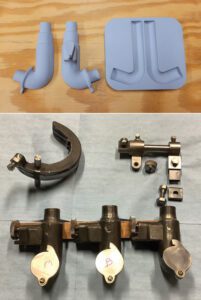
During the fall of 2021, my friend Ken McConnell and I traveled to see the Type B style engine in Michigan. This engine had a carburetor, so we took many photos and measured it. Ken built a CAD model of the carb and 3D printed one out for me to try on my engine. It was close, but required a few modifications to get it just right. The second printed part was good, so it was on to make the pattern and core box. Ken completed these in late January 2022. Patterns were shipped off to the foundry, with castings arriving by mid-March. These were then passed to Gary for machining at the Coolspring show in April.
The machining of the carbs was completed by the time of the Portland show. A governor weight and set of governor brackets were also ready for me to try on my engine.
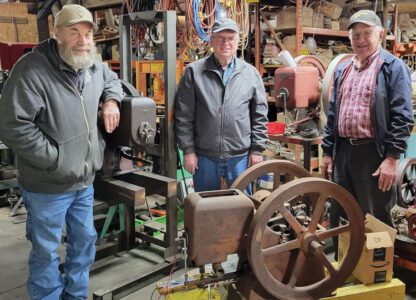
In January of 2023, we took a trip to southern Ohio, and added a stop to visit Gary. Walt came, too, and we got to check out Gary’s Type B-style engine, and see the progress he was making on ignitor trips. Due to the quirkiness of the ignitor and trip design on the Type B engines, Gary thought each individual engine would need a custom fit and might have unique parts to make the mechanics work properly. He thought it’d be best if I brought my engine to his shop, and Walt brought his engine as well. This allowed for trial and testing of the mech, and tweaking the parts to make it work.
March found us back at Gary’s place, this time delivering our United Field engines to be worked on. Walt had previously brought his engine, and he’d come for the discussion also. It was great to be able to compare the three engines. There were differences in each. Walt’s was the most different, with a rocker arm that was fabricated, and differences in the governor brackets. Gary and Walt had made a variety of ignitor trip parts, and we spent some time trying these on each of the engines and attempting to assess the differences, to determine what would work best for each.
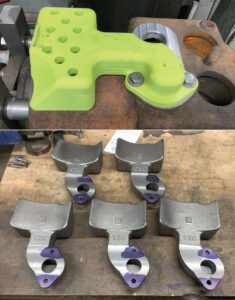
Dale Salmon had also found a Type B-style engine, carrying a Wonder nametag. This engine was quite complete, even sporting the original crankguard and muffler. Dale offered to loan me the muffler, so we could create a pattern from it. Again, my friend Ken was enlisted to measure and build a CAD model of the strange muffler. He was able to use a camera to see inside the muffler, finding cone shapes at each of the exhaust openings. It took a few iterations to get a close representation of the muffler. A 3D printed version was sent to Gary, and he confirmed it fit on both engines. Ken had the pattern and core box complete late in July, and these were sent to Cattail Foundry in Pennsylvania.
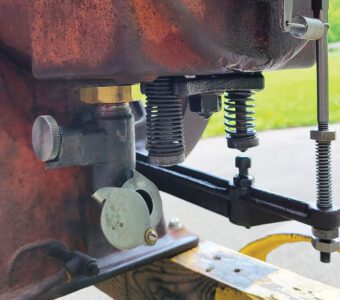
One other item of concern regarding my engine was the mounting for the carburetor. The remnant of the carb on my engine was fit to the block with a tapered bushing, likely just hammered up tight in place. Walt’s engine is similar, while Gary’s has threads to receive a bushing. Use of a tapered fitting didn’t seem to be a reliable mounting, so we decided to tap threads on my engine so a threaded bushing could be used. To accomplish this, Gary first milled off the surface where the carb and exhaust mount, then tapped the hole for the carb. A matching bushing was made, and a special washer was adjusted in thickness to allow the carb to tighten up in the correct orientation.
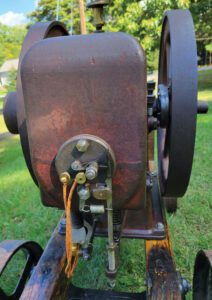
Gary checked the bore on my engine and found it slightly out of round, as well as pitted, so he honed it to clean it up. He also made a new piston pin and bushing. The ring grooves were found to be oversized too, and with the condition of the bore, it may require that the engine be bored, sleeved, and reworked to get the piston done. But we decided to try the engine first and see if it was runnable.
The United Field runs!
In mid-July, Gary had the engine set up to spin it over with one of his lathes. This allowed him to check out the governor to see when it latched up and when it’d release. He changed out the governor weight spring and landed at a running speed around 150rpm. He also said the engine had some compression, likely enough for it to run. Gary is very thorough and meticulous in his work – by far the most detailed and precise work done on any of my engines.
In early August, my wife Michelle and I went down to Cincinnati for the fourth time that year, this time to retrieve the United Field engine and take it back to Michigan. It was also time to see if we could make it run. We rigged up a temporary gas tank, as the tank on the engine hadn’t yet been cleaned out. Battery and coil were attached, and gas added to the tank. Gary manned the smart end of the engine, and I set to spinning the flywheels. It didn’t take much and we got it to fire. As I continued to crank it, the engine came to life and governor kicked in, but only for a few revolutions. It had some blowby out the back and up the oiler pipe, and was leaking from both valves. It was a great day, and it was super to see the United Field running and complete again.
Castings for the mufflers were done from Cattail just prior to Coolspring swap in October. It took some calling around, but I managed to find them a ride to Coolspring, and I made a quick solo trip to Pennsylvania for the swap meet. I was able to relay the muffler castings to Gary so they could be machined. Less than a month later, Gary sent me photos of the completed mufflers! Now, five more of the surviving Type B-style engines have proper mufflers.
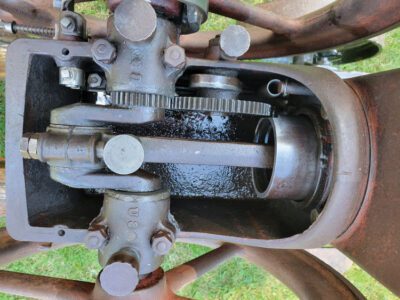
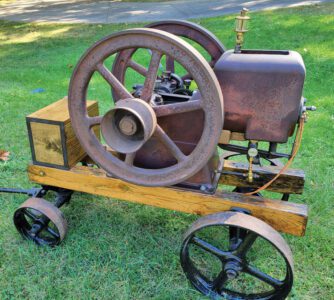
Our Type B got the remaining detail work done on it once home in Michigan. During 2025, the trucks were finished, and a battery box and wiring were added. The engine was started and run several times, making adjustments and minor fixes, and prepping for a first showing.
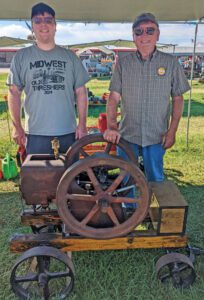
Midwest Old Threshers in Mt. Pleasant, Iowa, featured Field Brundage engines at their 2025 show. Thus, it seemed appropriate that this be the show for our United Field to make its debut. It was great to have the completed United Field on display at last!
Fellowship of the Engine
The restoration of our United Field engine was made possible by the efforts of many people. It’s a story of friendship and of working together for a common goal. My engine was missing so many pieces when acquired. It’s remarkable to have it complete and running in just five years’ time. Walt’s and Gary’s engines are also now complete.
My friend Ken played a key role in getting these engines back to complete. His skills in CAD and printing patterns made the difficult creation of new parts possible for this project and many others. Sadly, Ken passed away in August 2025 from cancer. His “can do” attitude and friendship will be missed.
The gas engine hobby is a true community that helps each other. Teamwork is a powerful force when focused on accomplishing common goals. I’m thankful for the many friends that shared this engine restoration journey with me. A Fellowship of the Engine. FC
Barry Tuller is a collector of gas engines and related belt-driven equipment, literature, and advertising. He enjoys learning about engines and researching the history of the people and companies that made them. He can be reached at BTEngines@gmail.com.