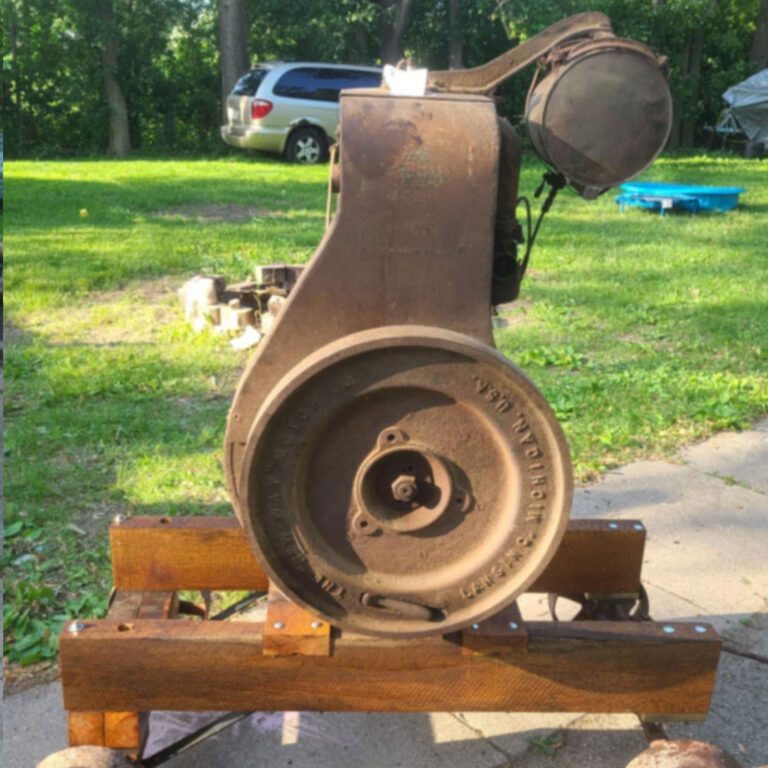
The concept of the “binder engine” appears to have first been proffered by The Cushman Motor Works in 1910. Their original offering set the format for all binder engines that followed. The engine was equipped with a single flywheel, throttle governing, and a PTO clutch opposite the flywheel. It was three horsepower, water-cooled, and advertised as multi-purpose. It could be attached to an implement in season, and then put on a stationary base or truck, making it more useful around the farm than for just running the binding equipment. Several other manufacturers followed suit with similar binder engine designs. (For more information on these, reference “Fairfield or Cushman Engine,” by Barry Tuller.)
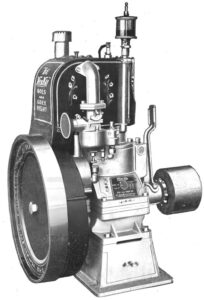
New-Way initially advertised that their 3-1/2hp upright S-A-C could be used for operating a binder, but it was likely too cumbersome with its pair of flywheels. The market for an engine to drive the machines of the “modern” farm was growing by the day as farmers added more and more machines to their operations. A specialized new engine would aid in this increased agricultural efficiency and benefit the modern farmer. The design required fresh thinking and advancement, but these principles were already the hallmark of New-Way.
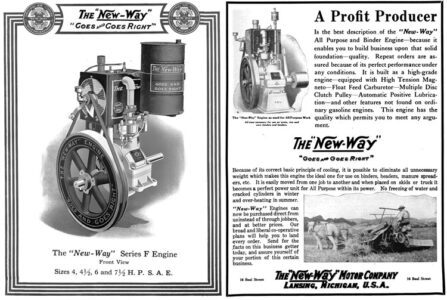
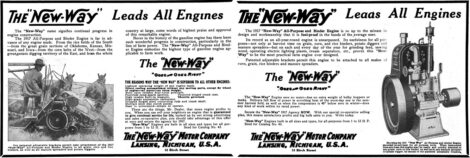
New-Way Motor Co. engineers introduced the new “Series F,” a series specifically tailored to binder work early enough in 1915 for it to be used for that year’s harvest season. It, like the others, followed the design format of the Cushman. Like all other New-Way engines, it was air-cooled, differentiating it from its competitors. The earliest advertisement the author has found was published in the periodical, Farm Implements, in December of 1915. Copy from this advertisement reads:
“Sell the engine that meets the greatest number of requirements – the engine that is light and powerful enough for any kind of binder work and at the same time is an all-around general-purpose engine. Such an engine is the New-Way – It makes the ideal power for Binder Work during harvest time and can be used for all kinds of general work the year around. First, and most important, is the fact that the New-Way has the least actual operating weight of any engine made. It is a compact unit with no awkward cooling system, and when we speak of weight we mean the complete outfit ready to run.” (1)
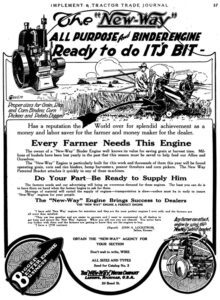
In January of 1916, New-Way launched a blitz of advertising in trade journals seeking additional dealers for this lightweight “All-Purpose and Binder Engine.” Another major selling point detailed in these new ads was their freshly patented “Engine Platform Mount,” a specially designed platform with rigging that would allow the engine to be mounted to nearly any grain, rice, or corn binder, potato digger, manure spreader, or other ground-driven horse-drawn farm implement, giving the farmer the most versatility possible. It was offered in four sizes in these advertisements: 4hp (Model D), 4.5hp (Model C), 6.0hp (Model A), and 7.5hp (Model E). Many of the ads also included a schedule of popular binder brands and sizes and the recommendation of which model of engine was best paired with each manufacturer’s implement (see 3 Page 6 of the New-Way Motor Co. Catalog D18B).
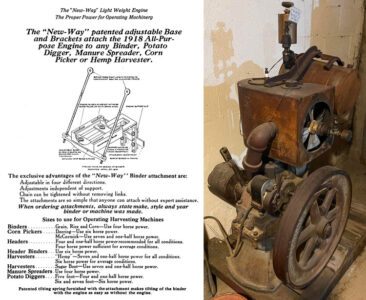
The Series F engine retained many of the design features of the Series S (Standard) engines. The hinged crankcase design was retained, which was lauded for its superior access to wear parts in the internals, such as the piston rings and connecting rod bearings for service. This design also sealed out dust much better than many other designs of the day. The majority of engine designs of this time featured an open crankcase.
New-Way engines had also been supplied with Bosch magnetos for several years at this point, but it was an extra cost option on the S and J (Jewel) Series of engines. It was standard equipment on the Series F. The gear train assembly driving the magneto was also adorned with a new throttle lever linked to a spring assembly controlling the carried-over flywheel mounted flyball governor.
On previous designs, to adjust the speed of the engine, the operator would have to stop the engine and use a screwdriver to adjust the tension springs individually on the two flyweights. The fingertip control offered by the new arrangement would allow the operator to adjust the speed almost instantaneously.
Another new feature on the Series F engines was a flip-out starting handle in the single flywheel for the convenience of its operator. Easy starting, smoothly governed, and variable operating speed, superior dust protection for long operational life, and the lightest operational weight in the industry for its horsepower offerings – New-Way truly felt it had hit a home-run with the Series F.
In the advertisements, the engine was lauded for the practicality of its air-cooled design, guaranteed to run without overheating and to “give indefinite service practically without attention in the hottest summer months or the coldest winter weather,” thus reminding potential dealers there’s “no fear of a water fractured block.” Filling the columns adjacent to their advertisements with glowing testimonials from those lucky few who were so satisfied and appreciative to have one of these fantastic Series F engines with which to harvest their fields so efficiently with in 1915.
Testimonials from the fortunate farmers who put the engine to the test were prominently featured in the pages of these periodicals also. Mr. Walter G. Glines, “a prosperous middle West Farmer” was particularly pleased with his New-Way engine:
“Mr. Glines had been using a Johnston binder for a number of years, and had always found it necessary to use three horses and considerable persuasion to get any speed at all in cutting grain. ‘Last season,’ he states, ‘I used a New-Way all purpose and binder engine on the binder, and in grain where I fully made up my mind that I would have to cut it with a mower or turn the hogs into it, I was able to save it. The engine operated the binder readily and easily in very heavy and tangled grain, and I used only two horses where it would have been impossible to cut with even three horses without the engine. In addition to this experience with the grain binder, I put the engine on a Milwaukee corn binder, cutting in the neighborhood of 75 acres of corn without a moment’s trouble and under conditions in which no kind of binder would operate if drawn by horses only. The engine cuts the corn more rapidly than by using only horses and does it with two horses on the corn binder as well as using only two horses on the grain binder.'” (2)
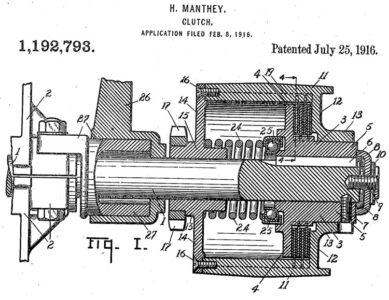
Testimonials also complimented another fresh New-Way patent – their multi-disk clutch (filed February 8, 1916). New-Way engineer Henry Manthey had developed this improved clutch specifically for the Series F engines. It was designed to be compact and robust, for years of trouble-free service. The clutch is an oiled multi-disk friction design with the clutch elements sealed within the belt pulley itself (see the patent drawing for New-Way Series F clutch). The only externally accessible portions of the clutch are the operator lever and the spring tensioning adjustment nut.
All other components of the clutch are protected from dust, extending its operational life greatly. All Series F engines could be equipped with this belt pulley clutch of the specified size for the engine. The “D” model also had a sprocket to ease its connection to chain drive implements.
New-Way routinely demonstrated a commitment to continuous improvement. Although their engine mount’s patent was not yet six months old, development had been progressing on a superior mount. William Drummond, under the direction of New-Way, filed patent documents for this improved mount on June 5, 1916. At the factory, engineers were working on other improvements for this new multi-purpose engine also.
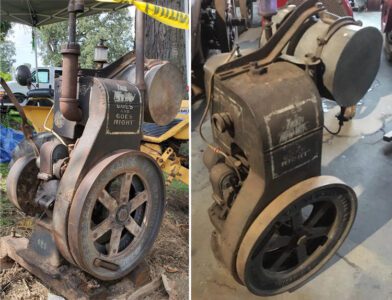
The 1915- to 1916-built engines were cooled in the same way as all New-Way’s previous engines, with a belt-driven propeller fan mounted on the head. The factory engineers felt that this cooling device could be improved upon. Created during the 1916 run, New-Way filed for patent protection on January 29, 1917 for their new cooling system. The engine was now equipped with a squirrel cage fan that was mounted to the rear face of the flywheel with offsets, and fully enclosed in a forced-air housing that directed all of this cooling air over the cylinder. A wire mesh screen was attached to the rear side of the housing, the point of air intake. This construction kept more of the chaff out of the array of cooling fins on the head, and eliminated the leather belt required for driving the cooling of the engine. It was the feature of all New-Way advertisements from that time on.
“Now they announce the 1917 model of the New-Way All-Purpose and Binder Engine, which reports and descriptive matter at hand indicate is a long step towards the ideal engine for binder and general-purpose work and up to the minute in design and workmanship.
“‘It is better than last year’s model, which itself excelled all similar engines,’ states President W. H. Newbrough of the New-Way Motor Co. It is so up-to-the minute in design and workmanship that it is practically fool-proof in the hands of the average user.” (3)
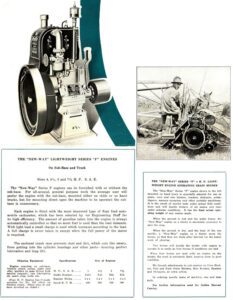
The changes to the engine added a small amount of weight to the overall units. However, New-Way continued to advertise the engine as “the lightest engine for all purpose and binder work (in actual operating weight) manufactured today. There is no water tank nor hopper – all cooling being direct without any moving parts except the revolving fly wheel of engine.
“The light-weight, together with jump-spark ignition from high tension built-in magneto; patented oil-tight, dust-proof, hinged crank case; throttle governed; high-grade automobile carburetor; drop forged steel connecting rods and crank shaft and multiple steel disc clutch, means that considerable thought has gone into the design of this engine, which not only was designed ready to place upon the market, but the new model was operated during 1916 at many points during the harvest season so that time-tried article would be put into the hands of the trade only after actual field service.” (4)
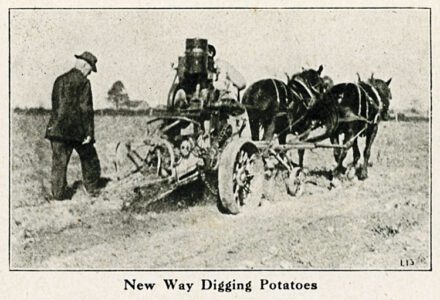
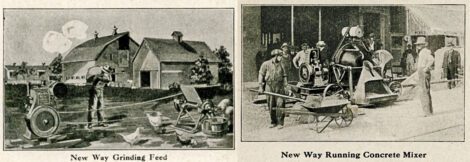
Throughout 1917 and 1918, the advertising blitz for the Series F continued, and the engines sold well. On the farm, the Series F engines were being switched to stationary work on saws, feed grinders, water pumps, and any other stationary purpose that could be done by belt work, then back to agricultural machines when in season. It was equally at home on the corn, grain, and rice binders of its original intention, and also on potato diggers, corn pickers, and manure spreaders.
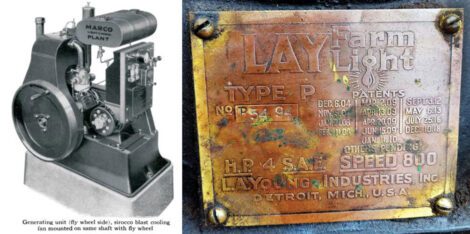
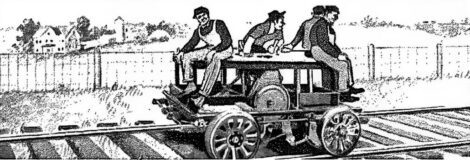
The Series F proved to not only be popular with farmers, but with a number of other equipment manufacturers as well. You could just as easily find a Series F engine as the power source on a “MARCO” or “LAY” light plant, a conveyor system, a concrete mixer, various road-working equipment, winches and hoists, railroad maintenance vehicles, and numerous other applications. Thousands upon thousands of these Series F engines continued to roll out of the plant. Some of these engines found service in WWI powering signal generators for the Allies. A Model E, 7.5hp Series F engine even landed on one of the first prototypes of a John Deere tractor!
Although WWI was raging in Europe and beyond, New-Way was looking ahead to the market opportunities that would arise as the veterans returned home. As successful as the Series F had been, newer and more efficient casting techniques had been developed through the crush of war production, and New-Way was working and learning, too. Never a company to be left behind, New-Way was busy developing their next engine, ensuring that it could continue to serve the needs of the modern farmer, while also being manufactured at a lower cost. This offered greater value and increased performance for their consumers. Electricity was still only readily available in more urban areas, and the 1918 International Harvester 8-16 tractor had just debuted with an all-new PTO shaft output, which would ultimately be the death knell to many self-powered implements. However, in the vast majority of agricultural areas the power provided by multi-purpose gasoline engines was still essential.
The market for construction equipment was also booming as the advances to the automobile had both urban and rural areas rapidly expanding the highway system. Series F engines were advertised as true multi-purpose engines, and shown to be equally at home on the farm, in the shop, on a worksite, or powering anything within its horsepower range.
The most popular size of the Series F engine was, by far, the 4hp-rated Model D. New-Way saw this and fixed their sights on a 5hp engine for development. The new design kept the fully enclosed cooling design from the Series F engine and targeted its shortcomings. It eliminated the hinged crankcase and the expense of its manufacture, and instead designed a lighter weight three-piece crankcase with a main body, removable full front cover (which also carried the crank and camshaft bearings), and an inspection access with cover.
For its 5hp model, New-Way designed and patented a new compact flyball governor bathed in oil. Its addition provided protection for this critical component from dust and dirt and it had a lever for direct and easy speed control adjustment. The new fully enclosed gear train provided a shaft drive for the Bosch high-tension magneto and had a cover that allowed easy access to adjust timing. This new design was the genesis of Series A, namely the Model C, Type H, or CH engine.
The Series A would ultimately prove to be New-Way’s last series of engines, carrying the company through to its end, about 1940. Read about the complete set of Series A engines in the “The New-Way A Series.” FC
Attributions
Patents:
- US1188242 – Engine Mounting, Branfield, 11-6-1915
- US1192793 – Clutch, Manthey, 2-8-1916
- US1247819 – Cooling Device for Internal Combustion Engines, Goodnow, 1-29-1917
- US1268698 – Adjusting Device for Harvesting Machines and the Like, Drummond, 6-4-1918
Citations:
- New-Way Advertising Department, “Preparedness Produces Profits”, Farm Implements, Vol. 29, No. 12, 31 Dec., 1915, pp. 13
- Staff, “Saved his grain with a binder Engine”, Farm Implements, Vol. 30, No. 2, 29 February 1916, pp. 22
- (3), (4) Staff, “The “New Way” Motor Company Announce their 1917 Model All-Purpose & Binder Engine”, Farm Implements, Vol. 30, No. 11, 30 Nov., 1916, pp. 50