Many of the gasoline engines we collect today are more than 100 years old. A few original factory buildings where the engines were manufactured are still standing, though threats of fire, decay, and urban renewal claim more of them each year.
As a collector, I find it more interesting when I know the history of an engine. Being able to see where the engine was made and learn about the people behind its manufacture makes for an even more fascinating story.
Root & VanDervoort – a short history
Root & VanDervoort Engineering Co. (R&V) was founded in 1899 in Champaign, Illinois. The company began manufacture of gasoline engines in 1900. Seeking more space to expand production, the company moved to East Moline, Illinois, in mid-1901. The company began a relationship with the John Deere Co. in 1902 that would be a boost in marketing their engines. The factory was expanded, and a small foundry was added. Still, the company could not keep up with demand and needed more space.
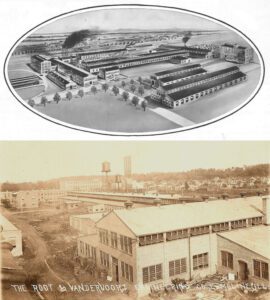
In 1904, a subsidiary company was formed to build automobiles: the Moline Automobile Co. R&V purchased a large tract of land several blocks west of the original factory on which to build a new factory. Construction of a much larger foundry and an assembly building for automobiles was initiated, and the factory became operational by 1905. During that year, additional automotive buildings were added to facilitate testing of engines and completed cars. A test track was also added.
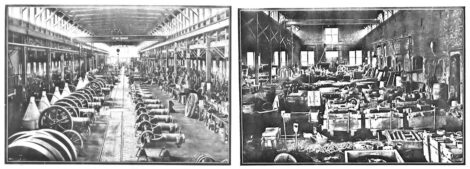
1906 saw even more expansion to the site, with construction of a massive machine shop, a building for testing engines, and an office building, along with expansions to the power house. These larger facilities would enable a tripling of production, and finally allowed R&V to complete the move of all their operations from the 1901 factory site.
More buildings would be added as sales continued to grow. In 1911, R&V launched its Triumph-style engines, which brought a quality and less costly engine to the market. The Triumph-style engines were quite successful, aided by Deere contracting for all of R&V’s engine output. This continued until Deere’s purchase of Waterloo Gasoline Engine Co. in 1918.
Production of single cylinder engines ceased shortly after this time.
R&V was greatly involved as a supplier of war materials during WWI. They built lathes, artillery shells, and large guns. Production of multi-cylinder engines for tractors, buses, and cars became the major business. Automobile production continued through 1924. R&V ceased operations as a company in 1924.
Engine and automobile production
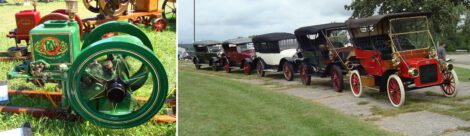
The company produced around 65,000 engines. There were six styles of engines offered during their production run from 1900 to 1918. The volume-governed style was the only one in production from beginning to end. The Triumph L-style engines accounted for about half of production.
Automobile production ran from 1904 through 1924. These were branded as the Moline, Moline Dreadnaught, Moline Knight, and R&V Knight. Approximately 8,800 automobiles were built.
After R&V – the factory
The factory was sold to Troy Laundry Co., which built commercial laundry equipment. Troy became Ametek Corp. and continued to operate at the site into the 1970s. QC Metal Pickling operated in the foundry building from 1982 through 2016. The other buildings of the old factory were mostly used for storage or stood vacant.
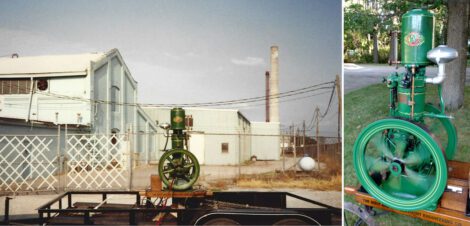
Two large gatherings of R&V enthusiasts have taken place in the last 25 years. The first was the R&V Reunion held in Atkinson, Illinois, in 2003. This event included a chance to tour the R&V factory buildings. In 2010, the R&V Expo was held in Mount Pleasant, Iowa. A bus tour to the R&V factory sites was included with this event. Five R&V cars were present at the factory and were posed for photographs on what remained of the test track. Both of these events were wonderful, and it was a great opportunity to walk through the R&V factory buildings.
New ownership and new life
The old factory site came under new ownership during 2017. In reality, it was a dangerous time for the factory. Mostly vacant, it was at risk of being torn down. The new owner was Larry Anderson, a lifelong resident of East Moline. Larry is the president of East Moline Glass, a family-owned business founded in 1960, whose plant is adjacent to the R&V factory.
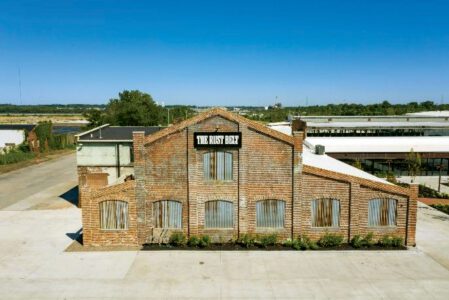
With his business acumen, and entrepreneurial spirit, and an appreciation for history, Larry was a unique match for the old factory. Over time, with the help of others, a plan came together to repurpose the factory. The vision was to create a concert venue inside the old foundry building, keeping much of the character of the structure intact. Other businesses would populate other buildings in the factory complex, including a brewery in the machine shop, a restaurant, and a coffee shop. This required a massive renovation to update the buildings while leaving the structural elements visible. The concert hall, known as The Rust Belt, with a capacity of 3,200, had its first event in February 2019. The brewery opened in July 2019, and the restaurant made its opening at the end of that year. Several other businesses have also taken residence in the old factory. The factory is alive again!
A day (and night) at the factory
I became aware of the transformation of the R&V factory during the fall of 2024. Checking online, I found information on the new businesses at the site and knew I needed to see it. I was particularly intrigued with the concert venue and started getting alerts for upcoming events. A super concert appeared on the calendar that fit our schedule, so I ordered tickets. I also reached out to Larry in advance of the event, and he agreed to meet up with us on the day of the concert and give us an inside look at the remake of the factory.
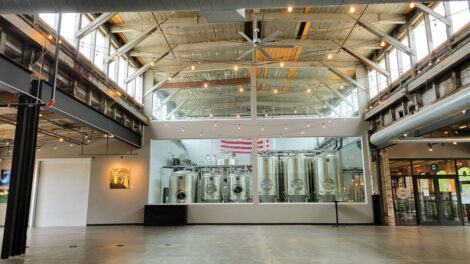
We arrived around noon on concert day and found the site was full of activity. The new parking area in front of the factory was nearly full, and the various businesses were busy. We enjoyed a good lunch at the Mexican restaurant, Jenny’s Boxcar. Larry met us inside the spacious common area of the old machine shop. What a change to the east, with a brewery now in the machine shop.We then toured the concert hall in the foundry building – such a nice space and so full of history. The old foundry manager’s elevated office had windows looking down on the floor – this had been turned into a VIP area to see the shows. Larry also shared with us some of his collection of products that were made in the factory, and he has plans to add these in a display inside the venue.
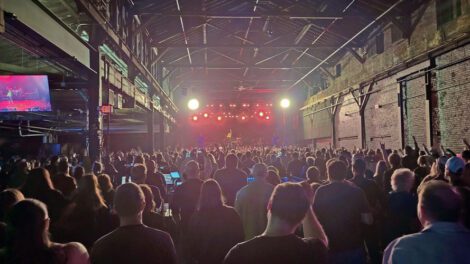
Prior to the concert, we checked out the brewery, Midwest Ale Works, and tried some of their brews. Back in the concert hall, we caught the end of sound checks for the warm-up band and found a spot to see the show. Plush was a really good band, and I’ve become a fan. The headliner was The Pretty Reckless, in the midst of a stadium tour with AC/DC. They had played Soldier Field in Chicago the night prior, to 60,000 fans. The Rust Belt is much more intimate – much more up close and personal. Acoustics in the old foundry were awesome.
We had a great time visiting The Rust Belt and seeing a concert in the old R&V factory. If you’re ever in the Quad Cities, be sure to check it out! Address: The Rust Belt, 533 12th Ave., East Moline, IL 61244. Online: TheRustBeltQC.com
Barry Tuller is a collector of gas engines and related belt-driven equipment, literature & advertising. He enjoys learning about engines and researching the history of the people and companies that made them. He can be reached at btengines@gmail.com.