
All of us engine enthusiasts have heard someone say, “I have a fat blue spark, but my engine won’t start.” We aren’t going to get that person’s engine started here in this paper, but let’s discuss that spark. A fat blue spark always seems to imply a strong or energetic or hot spark. I’ve often wondered then if a weak spark is skinny and red, or skinny and some other color.
In the early to mid-1800s, before the electron was discovered, William Crooks, J.J. Thomson, and others were experimenting with large evacuated glass tubes. One end of the tube had a heated metal filament, the cathode, while the other end was painted with a phosphorescent material, the anode (Figure 1).
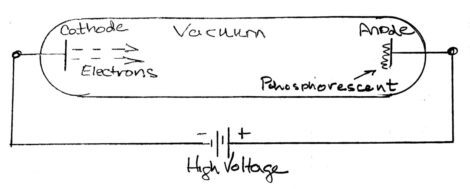
When high voltage was applied between the cathode and the anode, the phosphorescent material would magically light up. Further, when a metal Maltese cross was placed between the anode and cathode a shadow of the cross appeared on the anode. These early experimenters could see nothing in the vacuum but concluded something was emitted from the cathode, which they named cathode rays. What’s important to us is that a stream of electrons isn’t visible to the naked eye.
If the electron stream is not visible, what’s seen when an ignition system creates a spark? Physics tells us that, due to the high voltage, the electrons that leave the cathode of a sparkplug are traveling at a very high velocity. As those spark electrons encounter gas atoms, they’ll ballisticly knock electrons off the gas atoms, giving extra energy to the freed electrons. As those now free electrons reunite with their atoms, they must give up that extra energy. They give that energy up as light at a specific wavelength or color for any given gas (Figure 2).
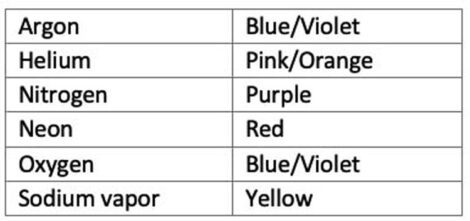
In a nutshell, the color of a spark, weak or strong, is determined by the gas the spark is traveling through. Our atmosphere is primarily composed of nitrogen (78 percent) and oxygen (21 percent) resulting in a rich dark blue spark. Weak or strong, a spark on your work bench will be that rich dark blue.
Once the spark begins and those high-velocity electrons are knocking electrons off gas atoms, the spark channel becomes very hot and flooded with free negatively-charged electrons and positively-charged atoms, a condition called a plasma. Plasmas are very hot, so the spark channel will appear white but the glow around the spark and the color an eye can see is determined by the gas the spark is traveling through. Further, plasmas are hostile environments with hard to predict characteristics. For that reason, it was decided to do a spark experiment.
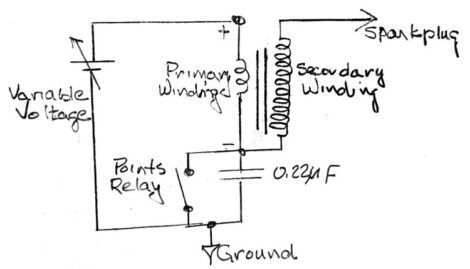
A standard high-tension ignition system is set up (Figure 3). As has been discussed in Gas Engine Magazine and Farm Collector, all high-tension ignitions from the late 1800s until today, whether in a gas engine, a farm tractor, or a modern automobile, use the Figure 3 schematic. To measure color and fatness of sparks for this test ignition, the points are the movable and normally closed contacts of a 5-pin relay. The relay is controlled by a square wave generator, thus allowing the spark rep rate and dwell time to be adjusted. The coil is a standard 12V, 1960s automotive style and the old Champion W16Y sparkplug had a gap of about 0.035 inch. The sparkplug wire is non-resistive.
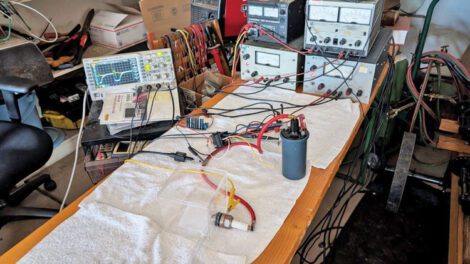
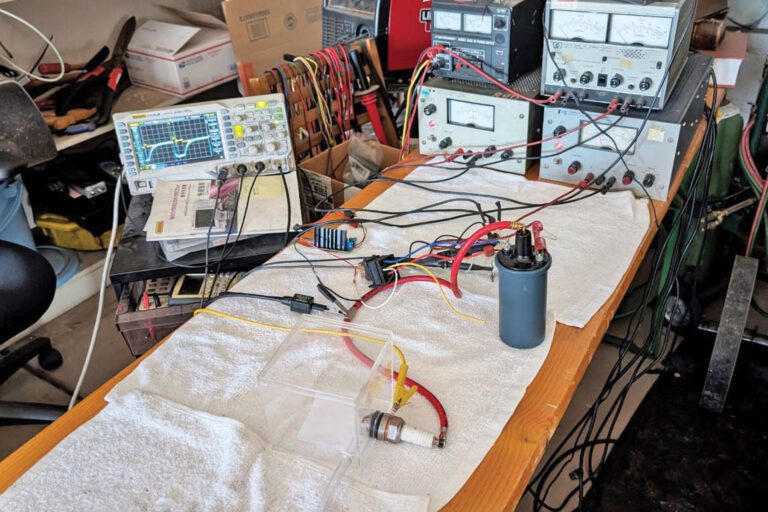
To reduce any air turbulence and to provide the best spark view, the sparkplug was mounted in a clear plastic box with a white background. In a magneto, as discussed in earlier articles, the strength of a spark is determined by the current flowing in the primary winding of the magneto at the time the points open. By adjusting the battery voltage of this test ignition circuit, the coil current and thus the spark energy could be varied from a minimum to a maximum. The bench setup is shown in Figure 4.
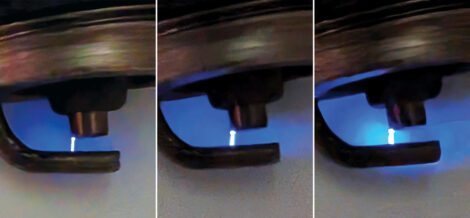
Sparks were created at three energy (hotness) levels: the minimum energy at which a spark was consistently generated, a medium level, and the maximum beyond which the coil core was saturated. Figure 5 is a minimum energy spark, 1.78mJ. That spark is about 0.008 inch wide, lasts about 0.010 second, and is blue but not very bright. Figure 6 is the medium energy spark of 7.0mJ or four times stronger than the minimum. This is an energy similar to most old tractor and high-tension engine magnetos. The spark is about 0.009 inch wide, lasts about 0.010 second and is blue. The intensity of the blue light is noticeably higher than the minimum spark. Figure 7 is a maximum spark, 15.8mJ or 9 times the minimum spark. The maximum spark is about 0.011 inch wide, lasts about 0.010 second, and is a very bright blue.
What the eye and brain are trying to see is a blue flash of light that’s 0.035 inch long (or the plug gap), about 0.010 inch wide, and lasts about 0.010 second. There’s very little difference between a weak or strong spark other than the light intensity. The flash isn’t very intense for a weak spark but intense for a strong spark. The saying “I have a fat blue spark,” then, doesn’t tell us much. It’s already known that it’s blue and also that it’s about 0.010 inch fat. To say the spark is bright or not very bright would seem to be much more descriptive.
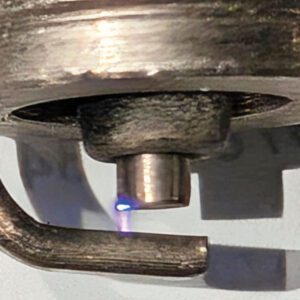
Helium is a gas that’s easy to find and relatively inexpensive. With the sparkplug mounted in a clear plastic box, it’s easy to test the Physics people’s claim that the gas determined the color. Figure 8 is the spark in a helium environment. Yes, the color is a pinkish orange. Unfortunately, there was much more background light for the helium photo so the background glow isn’t as visible as in the earlier photos.
Engine enthusiast Dr. Dave Cave is a retired electrical engineer living in Arizona. He welcomes you to contact him at JDengines@cox.net