
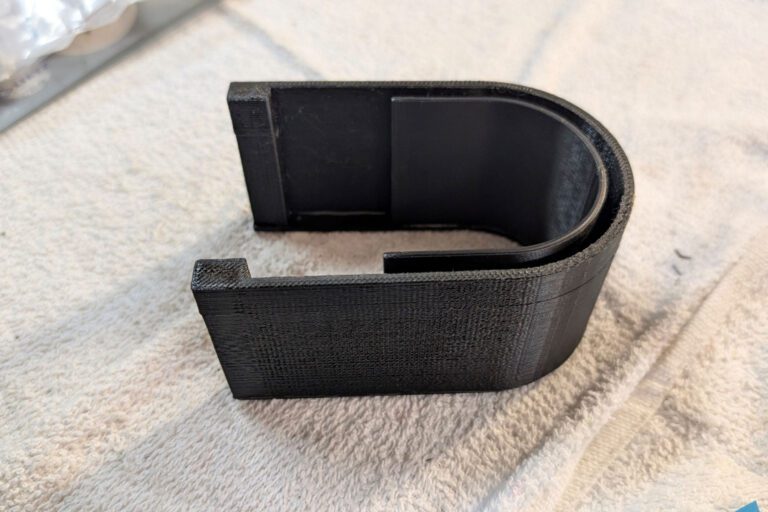
I’ve been asked many times if I could make a new magnet to replace a lost one or maybe one that’s weak and refuses to hold its charge. Further, the requesters are looking for an exact size, shape, and look replacement. Previously, short of using a foundry, the only way to replace a one-of-a-kind magnet had been to create an Evac-style magnet as described in “Rare Earth Supercharged Magnet.”
For an odd-size magnet, finding the proper thick-walled steel pipe and bar stock may be difficult. In addition, milling, welding, and a lot of man-hours are required to make an Evac-style magnet. With the popularity of 3D printing, could one easily print any desired magnet?
The cited Gas Engine Magazine article describes three physical requirements placed on the magnetic field for a low-tension magneto to function properly. First, all magnetic field lines form a closed loop. Magnetic field lines don’t wander off into space and disappear. Following one always results in returning to the starting point.
Second, some of the loops of magnetic lines from the magnet must pass through the iron core that the magneto armature is wound on. More lines through the armature core results in a hotter magneto.
Finally, some materials are harder for magnetism to pass through than other materials. Air is very difficult but iron can be thousands of times easier. Magnetic field lines will always take the easy path. Therefore, in a magneto, the easiest path for a magnetic field line to complete its loop must include the armature core.
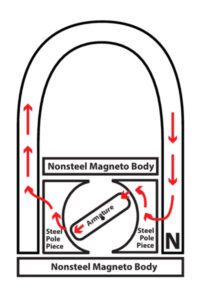
Early magneto companies adhered to those three rules, resulting in the horseshoe magnet and the architecture we’re all familiar with. The magnetic field passes through the magnet into an iron pole piece in the magneto body, through the armature core, out through the other magneto pole piece and into the magnet where it started (Figure 1). The only difficult parts of that path are the two tiny air gaps between the pole pieces and the armature core. That path is by far the easiest for the magnetic loops to complete their path. A better way to produce a good magneto hasn’t been found. Any 3D printed magnet will likely need to be structured like the early magnets.
The physical process of 3D printing is very similar to that of the inkjet printer attached to your home computer. Rather than squirting ink, the 3D printer squirts out a thermoplastic material. The printing material, called filament, prior to printing, looks like a spool of spaghetti, typically 1.75mm (0.070 inches) in diameter. It comes in many colors and, of interest to us, can be infused with many metals, including iron. In the printing process, the filament passes through a motor driven set of gears, which force the filament into a tiny hot nozzle that melts the filament. By controlling the drive motor speed, the thickness and timing of when filament is deposited can be controlled. An inkjet printer may leave a layer of ink only 0.000001-inch thick, whereas the filament deposited by a 3D printer is generally in the range of 0.004 inch to 0.016 inch thick. The exact thickness depends on parameters in the printer setup menu.
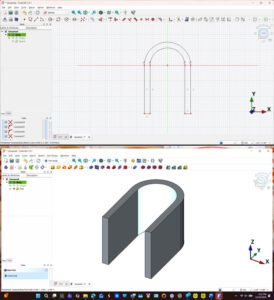
Before a magnet can be printed, a 3D software model of the magnet must be made. There are several apps for building the 3D model. Both Tinkercad and FreeCAD are free apps that’re easy to learn and use.
The process of creating the 3D model is straightforward. First, a 2-dimensional drawing is made of the magnet footprint (Figure 2). The app is then told to grow the 2-dimensional object vertically (Figure 3). Once a 3-dimensional version of the magnet is complete, the app slices the magnet model. After slicing, the magnet model is similar to a deck of cards, one layer stacked on top of another to create the 3D image. Each slice represents one pass of the printer. The printer prints the first slice, raises the print head the thickness of the first slice, then prints the second slice. That process continues for the 300 or so slices necessary to print a magnet.

An Iowa Dairy magnet, John Deere and Associated 2-bolt, was printed using iron-infused filament. The results were disappointing, although expected. No amount of time on the industrial Weidenhoff charger (Figure 4) could produce even a hint of magnetism in the printed magnet. The small percentage of iron filings in the filament result in no continuous iron path. Printing a hollow magnet and backfilling with iron filings fared no better, again as expected.
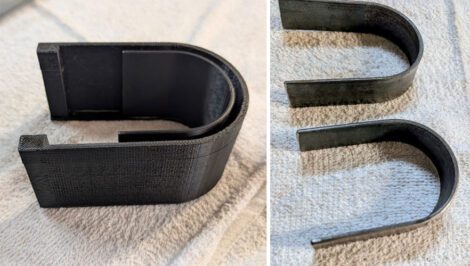
After more experiments, it became clear that to meet or exceed the usefulness of any OEM magnet, the printed horseshoe magnet must contain a solid iron core and likely receive its magnetism from rare earth magnet inserts, similar to the Evac magnet cited above. It’d be convenient if a thick horseshoe-shaped, 2-inch wide piece of bar stock could be placed on the printer table and have the printer print around it. Unfortunately, the large print head of all printers has virtually no head room, maybe 0.100 inch. As the printer tried to print the lower slices, it continually banged into the metal.
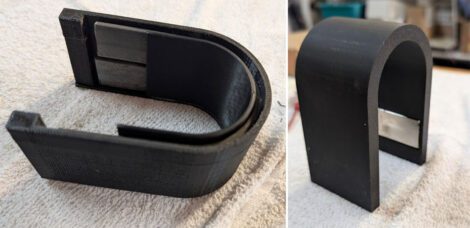
Printing a hollow magnet and inserting steel bar stock near the end of the printing process was decided on. The procedure for printing an Iowa Dairy John Deere magnet is as follows. The printer begins printing a hollow magnet but is paused prior to completion (Figure 5). The magnet in Figure 5 was taken off the printer bed for clarity. Two 1-by-1/8-inch steel bar stock pieces are pre-formed in the horseshoe shape (Figure 6) and dropped into the partially printed magnet (Figure 7). For ease of pre-forming, two 1-by-1/8-inch rather than one 2-by-1/8-inch bar stock inserts were used. The printer then completes the printing of the magnet. Finally, a 1-by-2-by-1/8-inch rare earth magnet is inserted in each leg (Figure 8).
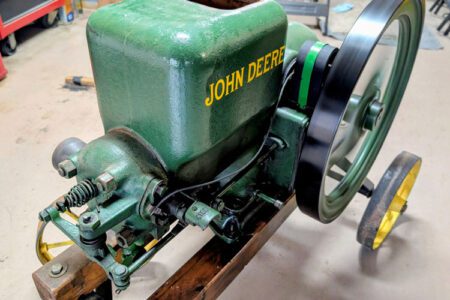
The printed magnet, using two pieces of 1-by-1/8-inch bar stock inserts, produced spark energy three times the energy of a recharged OEM John Deere magnet. The engine starts easily and runs smoothly (Figure 9).
Two layers of 2-by-0.035-inch sheet metal straps were tried as inserts rather than the 1/8-inch-thick bar stock. The sheet metal was certainly easier to form and insert, but the resultant spark energy was less than the OEM magnet. The engine would start, but not easily, and run. Thicker and wider inserts are key to getting a more energetic spark when using rare earth magnets.
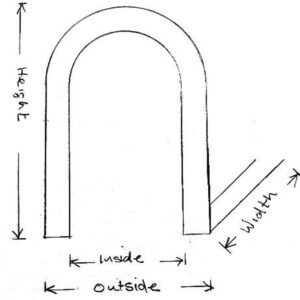
With the Iowa Dairy 3D model in hand, printing any other magnet only requires inserting the four dimensions shown in Figure 10 and pre-forming the desired inserts. I’d like to thank neighbor and engine enthusiast Doug Reynolds and neighbor and 3D printer enthusiast Frank Huppenthal for their help. Happy printing.
Engine enthusiast Dr. Dave Cave is a retired electrical engineer living in Arizona. He welcomes you to contact him at JDengines@cox.net