
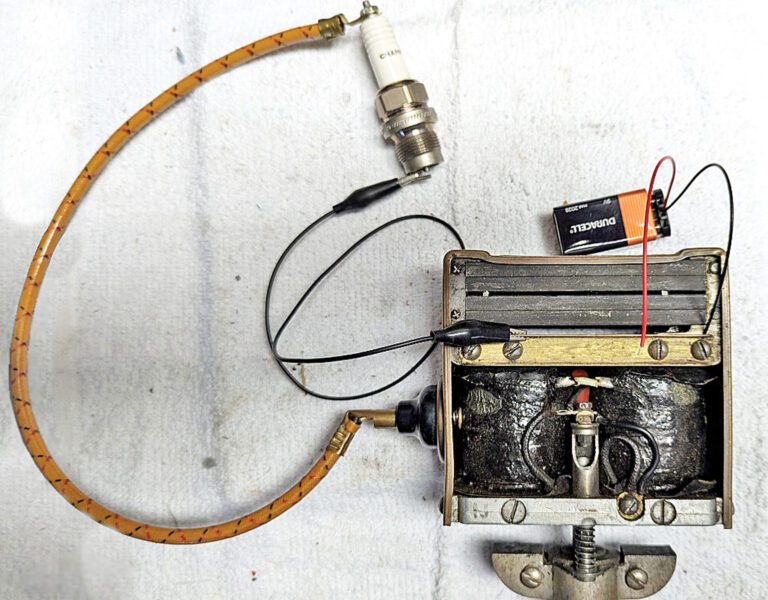
Hardly a month goes by that I don’t see a request for help with a non-sparking, high-tension magneto on one of the tractor or engine forums. It’s likely there are a lot more owners of bad magnetos out there who haven’t visibly requested help. Using an analog ohm meter or multimeter and a 9V battery, this paper is intended to give you the likely reason that your magneto isn’t producing a spark. The tests are simple, but will find the problem in the vast majority of cases.
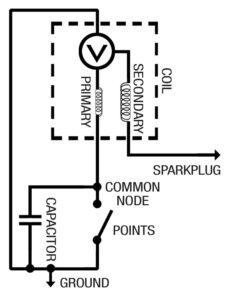
Fortunately, all high-tension magnetos have the same schematic. Whether you have a Model T buzz coil, an FM RV2B John Deere two-cylinder tractor magneto, a Maytag, a Wico EK, a Continental airplane magneto, or a 1955 Chevy, the components and connection are identical (Figure 1). The voltage source – V in the schematic – that causes current to flow in the primary winding when the points are closed is the only variation. The voltage source for a 1955 Chevy and a Model T buzz coil is the car battery. For a John Deere tractor magneto, the voltage source is a spinning cobalt or Alnico magnet. For a Wico EK, the source is a rapidly moving armature. For small Maytags and Briggs & Strattons, the source is a magnet spinning in the flywheel. This common set of components and connections makes it easy to diagnose the no-spark magneto because there’s no need to know the manufacturer or model of the magneto.
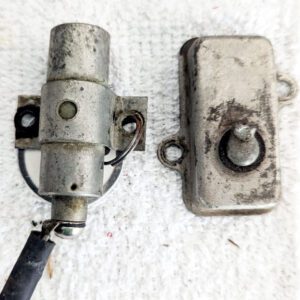
What’s commonly called “the coil” is actually a transformer made of two windings on a core. It’ll have three wires: one wire goes to ground, which is the magneto case; another wire goes to the points and capacitor (the common node); while the third coil wire goes to the spark plug. The primary winding will be a few 10s of turns of fairly fat, 20 to 16 AWG wire, while the secondary winding will be a few 100s of turns of much finer, hair-sized wire. Sometimes the secondary winding is wound first with the primary wound on top of the secondary, but the order is often reversed. The capacitor – often incorrectly called a condenser – has two terminals and is usually rectangular or cylindrical (Figure 2). One terminal of the capacitor will attach to the magneto case (ground). The grounded terminal is often the capacitor case and is screwed to the magneto case. The other capacitor terminal will attach to the important common node.
The points, a simple switch, will be opened and closed by an internal cam, e.g., the FM RV2B, or a trip mechanism, e.g., Wico EK, that is carefully synchronized with the crankshaft. One of the point’s terminals will attach to the magneto case, while the other contact attaches to the common node.
There are only three electrical nodes in the complete high-tension ignition: the sparkplug wire, ground, and the common node. The plug wire and ground are easily identifiable, so the first task is to find the common node. If you’re going to damage the magneto, it’ll likely be when you open the case to find the common node. Springs may fly out, or washers may slip out, or a wire may get broken. Other than possibly breaking a coil wire, it’s highly unlikely you’ll electrically damage the magneto. With the case open, look for a point where two wires (coil and capacitor) and one side of the points meet. Often, this node is actually one end of the points. Because this node is so important, some examples are provided to help find it on any magneto.
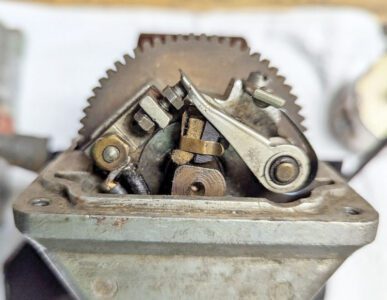
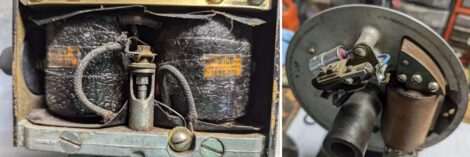
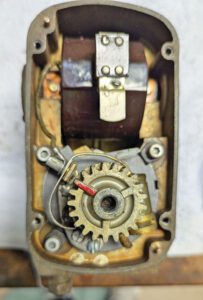
The common node on a Wico EK is the small nut on the top of the points (Figure 3). On a Maytag, the common node is the end of the points assembly (Figure 4). On a John Deere 2-cylinder tractor FM RV2B magneto, the common node is the brass nut where you see the capacitor wire and coil wire coming together on one contact of the points (Figure 5). On the American Bosch MJC4C 4-cylinder magneto, the common node is the round nut that the red line is pointing at in Figure 6. The common node will be isolated from ground, so it won’t be screwed into the case without insulators. Once the common node is identified, get the magneto in a comfortable position with the spark plug attached. Attaching the spark plug on a single-cylinder magneto is generally straightforward. For a multicylinder magneto, some rigging with a jumper or zip wire may be necessary to connect the high voltage coil output, center of the distributor, to the plug tip. Be sure to connect the spark plug case to the magneto case.
Diagnosing Magneto Problems
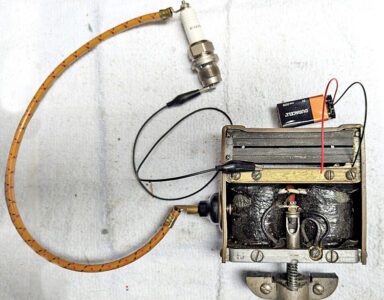
To diagnose a magneto problem, the first question should be “Is the magneto mechanically sound?” Look for broken wires, loose screws, or a poor contact between the coil and spark plug lead out. Are the coil, points and capacitor properly grounded? Do the points open and close properly? Is there excessive wear on the points rub bar? Are the shaft bushings snug? Don’t overlook checking the spark plug wire for continuity. That done, let’s see if the magneto is really dead. Turn the shaft till the points are open or open the points and put a thick piece of paper between the contacts. Connect the negative terminal of a 9V battery to the magneto case. Tap the common node with a wire from the positive terminal of the battery (Figure 7).
Did the spark plug spark when the battery (+) wire came off the common node? If so, the magneto is likely good and the problem is with the voltage source or timing. If the voltage comes from a magnet, recharge it. If there’s no spark, move on to the coil. With the points still open, put the analog ohm meter on the 1X scale and connect one lead to the magneto case and the other lead to the common node. The meter should show a very low, but not zero, value between 0.2Ω and 3.0Ω. If the reading is high (100s to infinite) or is zero, the primary winding is likely open.
The most common primary winding failure is open. Close the points, and the resistance should go to zero. If the reading doesn’t go to zero, the points’ contacts aren’t making good contact. Visibly check to see if they’re physically closed. Poor contact is very common on magnetos that have seen moisture. In the olden days, the cure for poor points contact was to slide a $5 bill back and forth between the two contacts. If that doesn’t work, try filing the contacts with a diamond file or replace the points. Now move the ohm meter lead from the common point to the spark plug wire, leaving the other lead on the case, and switch the meter to 100X. The meter should read several thousand ohms, 3kΩ to maybe 30kΩ. If the meter reads zero or infinite, the secondary winding is shorted or open. The most common failure is open. If either coil winding is bad, new or rewound coils can be found from various internet vendors and magneto repair shops. Other than a Wico EK, most coils are fairly easy to replace.
As stated, all high-tension ignitions have the same schematic, but the wire size and number of wire turns on both the primary and secondary winding vary by manufacturer and model. For that reason, a range of values that should be seen were provided for the primary and secondary windings. Luckily, the most common coil failure is an open circuit, so there’s no need to know the exact value of the winding resistance. In other words, if the resistance doesn’t read zero or infinite, it’s likely the coil windings are good. Just for interest, Figure 8 gives the approximate primary and secondary resistance of five common magnetos.
Magneto | Primary Resistance | Secondary Resistance |
Wico EK | 1.5Ω | 8kΩ |
Maytag | 0.2Ω | 10kΩ |
FM RV2B | 0.2Ω | 12kΩ |
AB MJC4C | 0.5Ω | 21kΩ |
FM 1042 C | 1.6Ω | 8.5kΩ |
Figure 8: Approximate resistance of the primary and secondary winding.
Capacitor Testing
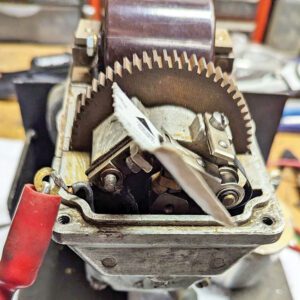
At this point, we’ve checked the coil and points. We’re left with the pesky capacitor. To test the capacitor, it must be disconnected at the common node (Figure 9).
Set the ohm meter on its highest setting, likely 100X, and connect one lead to the magneto case. First tap the capacitor’s disconnected lead to ground (the case) then carefully and quickly attach the other lead of the ohm meter to the open capacitor lead. Keep all your fingers isolated from the capacitor leads. The meter should blip down scale, maybe a quarter of the way toward zero, maybe halfway. If the meter is a very inexpensive one, the blip may be very small, a tenth or less of the scale.
After the blip down, scale the meter should slowly return to infinite resistance. If there’s no blip the capacitor is open. If the meter doesn’t return to infinite resistance, the capacitor is leaky. Before repeating the test, discharge the capacitor by taping the disconnected lead to ground again. This test doesn’t give the value of the capacitor, which is most often 0.2µF, but the most common failure mode is open circuit or leaky – not a shift in value. If the capacitor is bad, unless it has been recently replaced, there likely will be no markings with its value. The capacitance value of common magnetos is, however, available online. Replace it with a 600V poly film unit with the correct capacitance value. Poly film capacitors can be found on several internet sites, including Amazon. If the capacitance value of the magneto is unavailable, fortunately high-tension ignition is very forgiving as far as capacitor value is concerned. See, “Another Bad Condenser.” The claim that the capacitor must be replaced with one of the exact same value is folklore and not true. If the value of the capacitor is unknown and is a cylindrical capacitor and, if it physically fits, it can be replaced by one from a 1950s or ’60s Chevy from a local automotive store. If it’s rectangular, the space available may be very small. A 0.22µF 600V poly film capacitor from the internet will be smaller and will function well.
More serious problems such as the secondary coil winding arcing internally, the capacitor becoming resistive, internal timing issues, or thermal problems won’t be diagnosed with these simple tests. But as stated earlier, these simple tests will identify the problem in most cases. If, after reassembly, the magneto still isn’t sparking and the tests haven’t revealed an obvious problem, it’s time to send it off to one of the many good magneto shops.