

Hear from the Coolspring Power Museum founder Paul Harvey as he reminisces on an engine story from his youth and Maytag company history.
Why am I writing about Maytag when CPM has so many fine engines here? I guess it’s nostalgia creeping in. One day, I was thinking about some of my early engines, and the little two-cylinder Maytag popped into my mind. Gosh, I sure had fun with it way back then. “Then” was almost 60 years ago!
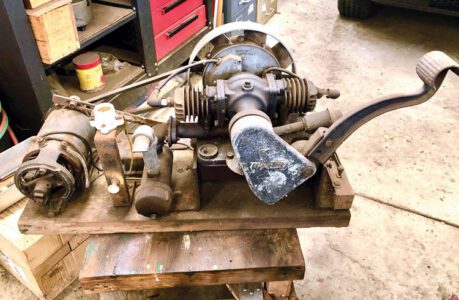
Beginning in 1957
When I was a freshman in high school, the science class had a section on engines. Many of the guys brought in examples, and I was impressed. I had fooled around with a little old Briggs & Stratton that my dad had but had never seen any of these two-cycle models. One kid had a two-cylinder Maytag, and I bought it for $2. Wow! A little two-cylinder gas engine! Now, what to do with it? So my dad and I spent a winter taking it all apart, learning how it worked, and even making a base for it. No internet then, so we were on our own. Try something and whoops, wrong thing, so try again and, gosh, it works! I had fun belting it up to several applications – some were not very successful.
The college days, 1963
When I was in college at St. Vincent, Vincent, I found a 1948 Olds woody station wagon when I was exploring the junkyard. I took off the generator and regulator and made a light plant with the Maytag. It worked great with 6-volt light bulbs; they were common in the hardware store then. So, the little engine lived again. I even took it out to Clear Creek State Park on some camping trips and used it to light a little Shasta trailer. Gosh, those were the good old days. It worked so well, as long as no one was near enough to complain!
Fast forward to 2021
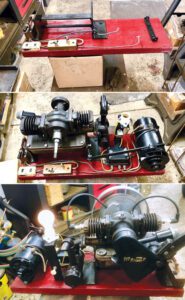
Considering the long winter ahead, I asked Kenny and Bo to bring the engine over to my warm garage so I could get it running. I needed a project to keep me busy through all the cold and snowy days. I thought I was quite ingenious then, but looking at it, I became disappointed in my shoddy workmanship. I guess I was always in a hurry.
Fredrick Louis Maytag
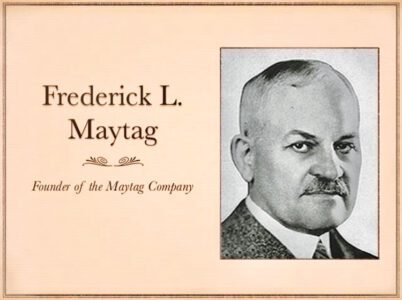
There has been so much written about the Model 72 Maytag that I don’t think I can add any more. Manuals and parts are available online now. But who invented them? So, let’s take a look into that.
Fredrick Louis Maytag, later known as F.L. was born July 14, 1857, in Elgin, Illinois. He founded the Maytag Corp., which was finally acquired by Whirlpool in 2006. I’m sure many of us have at least one Maytag appliance in our homes.
He was the eldest child of 10 children born to German-Jewish immigrant parents. The original name was Maitag, meaning May Day in German, but it was Americanized to Maytag. They didn’t have much, but they were determined to find a home in the American Midwest, then known as The Frontier. That they did, but F.L. was determined to go further. His is a great story of success, rising from such humble beginnings. The Great American Dream coming true.
Maytag Corp. timeline
1893: F.L., with his two brothers-in-law and George Parsons, established a company to manufacture farm implements. After all, agriculture was the main occupation in the new Midwest, and anything to make the farmer’s life better would be well accepted. F.L. proved to be an ingenious inventor, seeing the needs of the people. He was soon in control of the entire new company and expanded into other products.
1907: F.L. turned to washing machines. The first ones were hand-operated but easier than the competition. They sold well. He had a new successful market going, but now to make it better. In 1911, he invented a little gas engine and added it to his washing machine. They sold like hotcakes! Can you imagine running a cantankerous and stinky gasoline engine today to wash your clothes? No, but it was wonderful in its day, and a great new business was started.
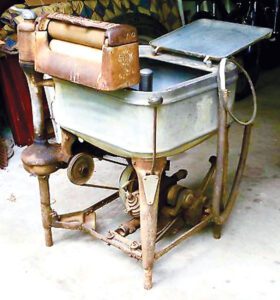
The history of Maytag engines is well-documented and will not be discussed in this article. Briefly, there was a variety of vertical models that transitioned to the well-known single-cylinder model. These worked well but were always rough running.
The twin came out in 1937 and lasted until 1952, when gasoline engine washing machines were discontinued. With their improved governing system, they were smooth running and pleasant engines.
1922: Maytag came out with the Gyrofoam washer, which placed the agitator on the bottom, instead of the usual top agitator. This worked well and, again, sales boomed. This design also pioneered the aluminum square tub. Finally, the leaky wooden tub was gone. Producing a one-piece aluminum tub was quite an accomplishment in that day. With improvements, this design lasted for many years and led the washing machine industry.
1927: F.L. produced his one millionth washing machine.
1940: Fred Maytag II, grandson of the founder, took over the business after F.L.’s death. It continued to prosper. His American Dream came true.
Community Impact
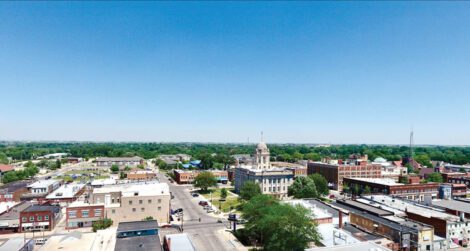
F.L. Maytag did so much for his hometown and factory location, Newton, Iowa. That town of 15,000 people is located in east central Iowa, on I-80. It was a pleasant place to live and work.
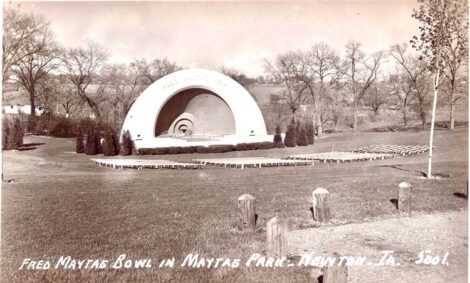
He donated 40 acres in southern Newton for Maytag Park. The park included manicured gardens, quaint paths and a band shell for relaxed summer concerts. This is still used today.
He spearheaded a new theater and water plants for the city. Newton became a model city for the Midwest. Building hundreds of houses for his workers, he sold them on long and easy terms.
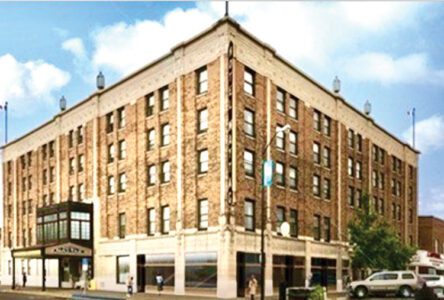
F.L. also built and donated the Maytag Hotel, which was very convenient to the many visitors. The hotel still exists today, offering beautiful one- and two-room apartments at reasonable prices.
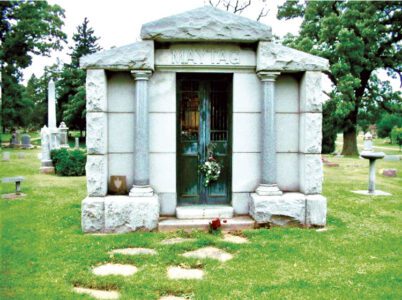
F.L. passed away from heart problems at his winter home in Beverly Hills, California, in 1937. What a life he had! He left an estate worth $10,000,000 ($184,000,000 today). A special train brought his casket and scores of mourners back to Newton. There, more than 10,000 employees and mourners formed a line five blocks long to observe the funeral processional. He was well-loved! He is buried in the Newton Union Cemetery. And so, his legacy came to an end.
Back to the Maytag restoration
I really could not improve on my original design, but I could pay attention to detail and make it more attractive. Paint always does wonders! It was easy to accomplish.
The engine did not get painted as its original finish was still nice after a thorough cleaning. But all the other parts had a lot of rust under the dirt, so they got spruced up with satin finish black paint. The generator had already been taken apart and cleaned. All wiring is original and cleaned easily.
After many years of hibernation, the little Maytag is now powering a 12-volt 50-watt light bulb. To me, it was a great trip down memory lane as well as a rewarding project.
It will be displayed at the Machine Works building at CPM. Why not visit us this year so you can see for yourself?
Now, on to the next project!
Dr. Paul Harvey is the founder of Coolspring Power Museum and a regular contributor to Gas Engine Magazine. Email him at engdoc8@gmail.com.
CPM is a 501(c)(3) non-profit corporation, and donations are tax-deductible. Please send donations to Coolspring Power Museum, 179 Coolspring Road, Coolspring, PA 15730. To learn more about the museum, visit the Coolspring Power Museum website.