In the early 1980s, I purchased an old John Deere tractor and some miscellaneous oilers and magnetos from a farm about two miles from Cherryville. The gentleman I was dealing with was in his late 70s. We started talking about gas engines, and he informed me that, years ago, they had a large one on the farm.
In 1940, his father passed away. Five years later, there was an auction where everything was sold, and he purchased the farm. I asked him if he knew what kind of engine it was. He replied, “It was a large Dieter engine.”
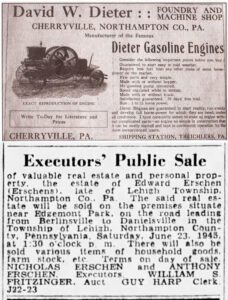
I made the comment that it was too bad you didn’t know what became of the engine, or if it even possibly still existed. To my surprise, he told me he knew where the engine was! His brother had bought it at the sale, but he didn’t know why, because he could never run it when he was on the farm. He had it on the edge of a bank, and it was ready to fall over into the ditch. I told him I was going to talk to his brother but he told me “Don’t bother; he won’t sell it.” I talked to his brother, and it was not for sale, even with a decent offer.
As time passed, I was informed that the owner was ill and, later, that he’d passed away and I should talk to his son because he might be selling some of his father’s belongings. I thought I’d let things settle down after his death before I would approach the son. I waited too long; the engine was sold. The grandson of David Dieter purchased the engine.
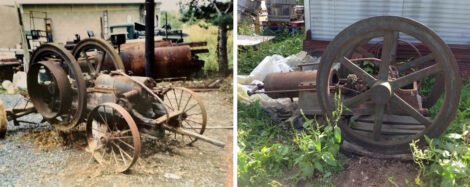
I got busy with work and family and didn’t know that all the engines bought by Dieter’s grandson were put up for sale. Years later, I talked to a collector and friend of mine, finding that he and his father had bought a Dieter engine. His father passed away and he wasn’t doing anything with the engine so I asked, “Is it for sale?” His reply was “No.” I asked if I could, see it and we walked over to a partially covered engine in the weeds. It was the engine, minus the cart, that I’d tried to purchase years before! He told me he’d give me a first chance if it went up for sale. A couple of years had gone by, and we met at an auction. We talked about the engine, and when I gave him a fair offer, the answer was still “no.” At least three years went by before I saw him again. Catching me totally by surprise, he asked “did you come for the engine?”
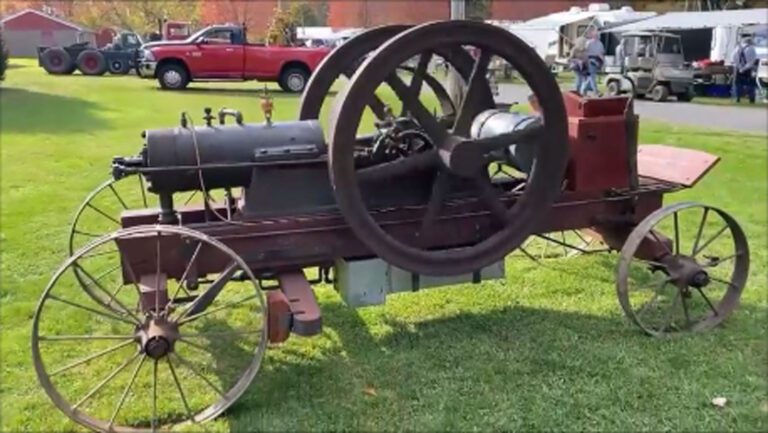
We made the deal, and I brought it home. Amazingly, the piston was free in the bore, but the rocker was broken into three pieces, the exhaust valve stem was bent, the head and cylinder had some old ugly brazing repairs and cracks, and the connecting rod was welded back together on both ends. But because it was one of only 11 David Dieter engines left, and the only one of the 12 horsepower size, it was a worthy project.
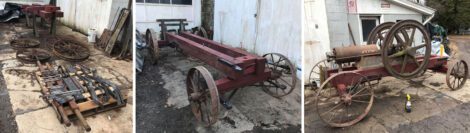
I decided to first try to make a cart as close as I could to a Columbia cart. From my research, it appears that it’s the type of cart that was used by Dieter for his engines. I had a set of wheels and axles, and the wheels were suitable, but the axles were round and I needed square ones – so I boxed them with angle iron. I had a local sawmill cut timber for the main rails, axle bolsters, and brake beam.
The wood was cut, notched, and drilled, and the bolsters were shaped. Then it was all stained. Using a coal forge, we made all the flathead and U-bolts needed and bent all the bracing for the cart.
After the cart was mostly assembled, we thought it looked way too large. The main beams are 6 inches by 9 inches by 10 feet.
A week later we set the engine on its cart, and it looked just right! Now that it was movable and at a good height to work on it, I could attack the mechanics before finishing the odds and ends on the cart. First was to pull the head off, pull the rod and piston, and check the bore. The bore looked excellent.
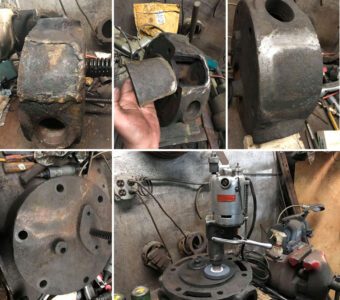
The head was the next thing to attack. The exhaust valve stem was cut off so the valve and spring could be removed. All the old brazing was ground off so the cracks could be repaired by stitching. One broken piece totally fell out. It was prepped and stitched back in, along with all the other cracks in the head. A new valve stem was made, the original valve head was used, and the valve seat ground and lapped.
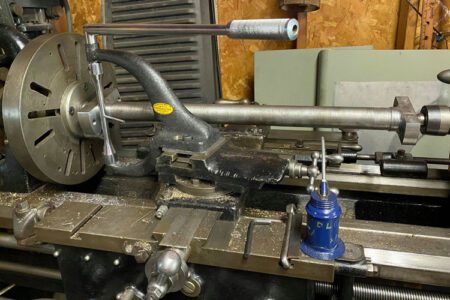
All the brazing was ground off the cylinder and the cracks were repaired again by stitching.
The rocker arm, broken into three pieces, was fusion welded back together using cast iron for a filler.
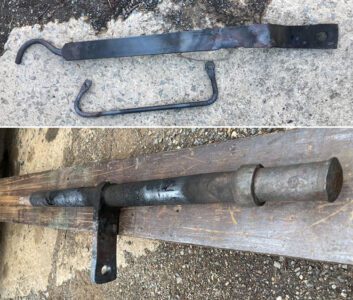
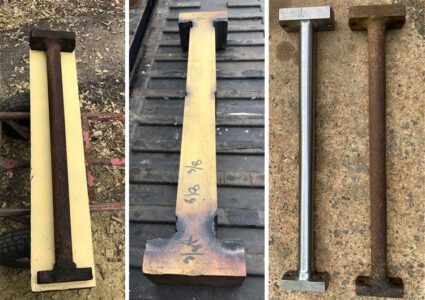
Because the connecting rod appeared to be made from three pieces and had a weld repair on both ends, we decided to make a new one-piece rod. A piece of rectangular bar stock large enough to cut out a new rod was purchased. We drew a rough shape on it and cut it out, and from there it was machined.
A large engine on a cart needs brakes! Back to the forge! Time to make the brake lever, cross bar, and equalizing/pull.
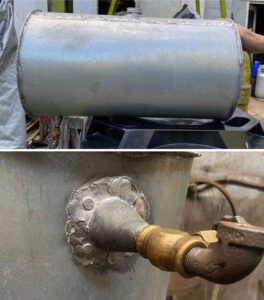
About the only items left to do were a gas tank, cooling system, and battery box/seat. After deciding what size gas tank would look good, and would hold approximately 20 gallons, sheet metal was rolled, and end caps made. A riveted seam, with riveted-on funnel outlet, was made for the gas tank. Mounting straps were formed and riveted together.
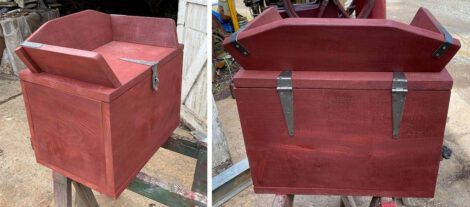
A seat battery box was made to replicate how it would’ve been made on a Columbia cart.
To the best of my knowledge, the tank-cooled Dieter engines had a water pump on the skid or cart that was driven by a flat belt via a pulley cast on the inner hub of the pulley side flywheel. A barrel probably would’ve been used to hold the cooling water. The original pump was long gone with the cart. We decided on a cooling tray under the cart with a built-in pump. Sheet metal was bent riveted, and soldered, and mounting brackets made.
Now the time had come to fire it up for the first time since the 1940s. A little gas in the primer, rolled it over, and it was running.