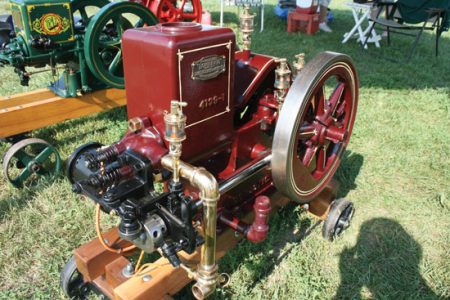
Few of the pioneer builders of gasoline engines are known by name today. Dave Lennox is a rare exception. In the 1970s, he was introduced as a character spokesman for Lennox furnaces, portrayed by an actor dressed in bib-overalls and a cap. Over the course of 44 years (until 2016), the Dave Lennox character was featured in advertising, extending his legend as a technology innovator.
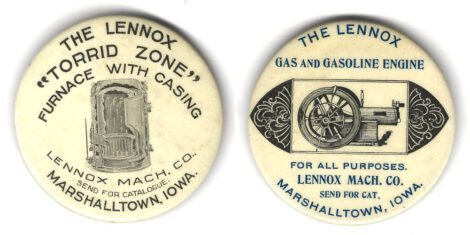
The beginnings of the Lennox furnace can be traced to 1895, when two men came up with a new concept for a riveted steel furnace. In 1896, the fledgling company came to Dave Lennox in Marshalltown to have him build the machinery and tooling for the furnace. Unable to pay Lennox for his work, the men settled their debt two years later by turning over the design and tooling to him. Lennox then refined the design to improve cost and manufacturability, and with the name “Torrid Zone,” began production. The new furnace proved popular and was advertised regularly, driving significant sales.
Furnaces weren’t what Dave Lennox wanted to spend his time and energies on, so in 1904, he sold the furnace business to a group of investors, who called their company “Lennox Furnace Co.” The company is still in business today as Lennox International, and still has a factory in Marshalltown.
After the sale of the furnace business, Dave Lennox’s focus returned to his long-time company, Lennox Machine Co., and the building of gasoline engines and other products.
Lennox – Feature Gas Engine 2026
Midwest Old Threshers at Mt. Pleasant, Iowa, will be featuring the gasoline engines made by Lennox Machine Co. of Marshalltown, Iowa, at the 2026 show. It promises to be a great show, as Lennox made many unique and interesting gas engines, and we’re hopeful to get a big turnout to showcase the variety.
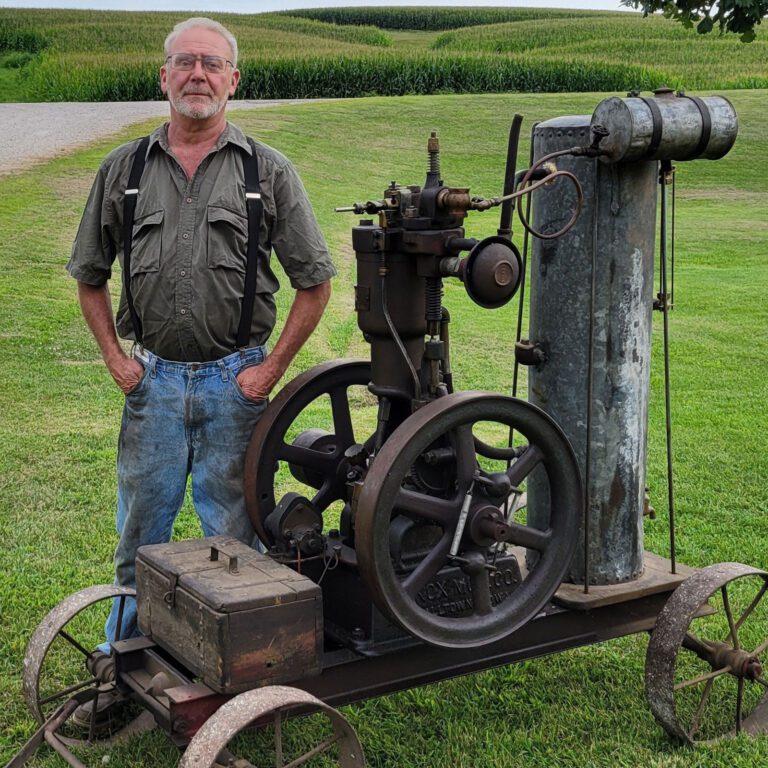
Our featured gas engine exhibitor for 2026 is Jerry Balvin of Chelsea, Iowa. Jerry got his start in the engine hobby about 50 years ago when he came across some engines at a house on his newspaper route. His first engine, a John Deere, would later come from this place.
The collector bug had bitten, and more engines would soon be added. Now, many years later, Jerry has assembled quite an impressive collection of engines.
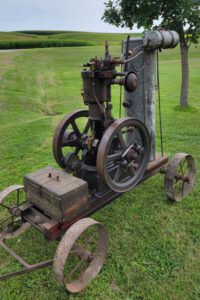
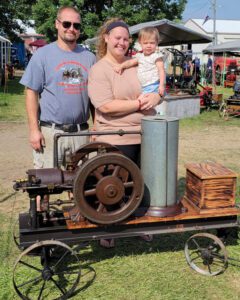
Jerry will be bringing a rare vertical Lennox engine for the feature display. Vertical Lennox engines of this style first appeared in advertisements in March of 1902. They were regularly included in advertisements through 1906, with availability as special order as late as 1913. This style is distinctive, as it has a C-shaped open crankcase. The engines were offered in two sizes, 2hp and 3hp, with this one thought to be the smaller size.
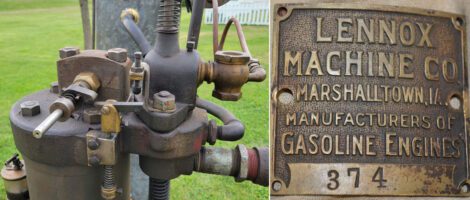
The engine’s working history is unknown. It has been in collectors’ hands since at least the 1980s, being a part of big collections in South Dakota, Minnesota, and Iowa before Jerry was able to add it to his collection. The original ignitor was replaced with a spark plug long ago. Jerry is a skilled craftsman and machinist and was able to build an ignitor and trip system to match the original. He mounted the engine on a heavy cart and added cooling and gas tanks, a battery box, and a flywheel-driven magneto. The engine now runs very well, and we’re excited to have Jerry and the vertical Lennox at the show!
Dave Lennox Early History
Dave Lennox was born in Detroit, Michigan, in 1856. Dave’s parents, Ellen and Martin, were immigrants to the U.S. (from Ireland and Scotland respectively), and met and married in New Jersey in 1854. Martin worked in the railroad shops in Detroit. In 1858, the family moved to Aurora, Illinois, where Martin worked at heavy forging in the car shops of the CB&Q railroad.
Martin volunteered to serve for the Union in the Civil War. He was killed in the Battle of Champions Hill, a precursor to the siege of Vicksburg. At age 7, David was sent to an orphanage in Springfield, Illinois, where he received two years of public schooling and served as a kitchen boy. At age 9, he returned to Aurora, where he worked to support the family in the boiler shops of the CB&Q as a rivet beater, earning 50 cents for a 10-hour day.
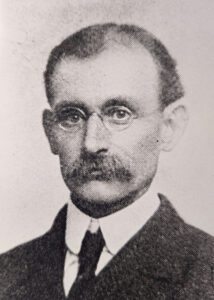
In 1868, the family moved to Chicago, where David’s mother ran a grocery store. David helped out in the store and sold newspapers on the street corners in downtown Chicago. After the Great Fire of October 1871, there were many jobs rebuilding the city, and David was able to make $2 per day. In the mid-1870s, work became hard to find, and David had to walk 3 miles to work as a lather’s helper for 75 cents per day. Along with his younger brother Talbot, he also repaired sewing machines in the back of his mother’s store. As a young man, Dave found time to attend night school and later business college.
Dave Lennox – the Inventor and Entrepreneur
In 1880, David was persuaded to come to Marshalltown, Iowa, by two friends who had been customers in his mother’s store. He arrived in Marshalltown by train on July 3. He was able to find a 20-by-20-foot space in a building at First Ave. and Church St., where he opened a machine shop. The first few months were lean, and he didn’t make enough to pay his rent. A big break came when he got a job to create a machine to cut barbs for the local barbed wire factory. The machine greatly increased output for the factory, helping establish Dave as an inventive problem solver.
Lennox’s mother and siblings moved to Marshalltown in October, and his brother Talbot joined the machine shop. They began making boilers and steam engines, and also took on repair work. At this time, Lennox designed and patented the Throatless Shear, to cut heavy steel plates. This proved quite successful, and many were made and sold. The need for more space prompted a move into buildings at 610 East Boone St. in 1884. The business was incorporated at this time, with capital of $20,000.
Many products were born of the inventive mind of Dave Lennox. In the early 1880s, he was asked to find a solution to tapping water and gas mains under pressure – this resulted in a patented tapping machine that was produced for the next 20-plus years. Well drilling rigs were added to the product offerings in the 1890s. The Lennox Machine Co. built safes for use in homes or small businesses beginning in 1904. In about 1905, an accurate and easy-to-install pitless scale was introduced, appealing to grain dealers, farmers, and quarries. This was advertised extensively and was a staple in the line through at least 1913.
A special favor resulted in yet another product. A stonemason asked Dave to make him a trowel. It was so well-liked that Lennox got requests from other masons for the trowels. Not wanting to be in the trowel business, he turned it over to longtime friends, Jesse and Lester Williams (who both worked at Lennox Machine Co., rising to plant superintendents). The Williams brothers grew the business, and it became known as Marshalltown Trowel Co. It’s still in business today, as the Marshalltown Co., making quality construction tools and equipment, and still has a factory in Marshalltown.
Gasoline Engines
Existing evidence points to Lennox getting their start in gasoline engines in the 1893-1895 timeframe. Ads begin to appear by 1898 for engines, and a catalog was available. The 1890s were a challenging time for Lennox, as he bought out his shareholders from 1890 to 1893, and his brother Talbot left the business in 1892 to become a professor at Iowa State College. In September of 1894, a fire destroyed the pattern shop at the factory, with a $12,000 loss and only $1,000 insured. Initial years of gasoline engine production was likely quite small.
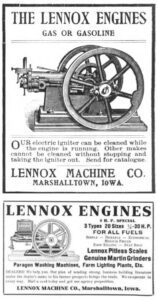
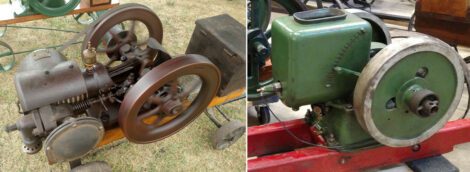
The earliest style of engine offered became known as the Standard, ranging in various sizes from 2hp to 35hp. Hot tube was the ignition source on the earliest engines, with an electric spark ignitor added as an option prior to 1900. Engines could be equipped with either ignition type or both. The Standard engine changed little in its 20-year production run, and ad images showed the hot tube ignition style until the end.
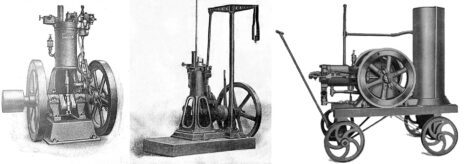
A small vertical pumping engine was introduced in 1899, in 1-1/2hp and 2-1/2hp sizes. This unique engine featured an open-sided A-frame, and a single flywheel. A geared, walking beam pump jack was included as a component. The engine was advertised with the names “Little Daisy” or “Little Giant.” It was only in the line until early 1902, when the C-frame vertical was introduced.
The Lennox engine line was enlarged in late 1904 with the introduction of a new 2hp horizontal tank-cooled engine. A unique feature of this engine was its extended subbase for mounting a tall cooling tank. This style of engine became known as the O.K. engine, and was the basis for additional line extensions. O.K. engines with air cooling, screen cooling, and hopper cooling were added by 1908, in sizes from 2-1/2hp to 7hp. Engines could be equipped with electric ignitor or sparkplug, each option having its own valve operating design. A 1-1/2hp air-cooled engine was first advertised in 1909, which featured the base, crankcase, and cylinder all cast as a single part. It was an attempt by Lennox to offer lower-priced engines. Lennox also offered a two-cylinder opposed hopper-cooled O.K. engine for a time.
The last style of engines offered by Lennox would be small two-cycle engines of 1/4hp, 1/2hp, and 1hp. These were introduced in early 1913, and were last referenced in ads during 1914.
Later Years – Workers Strike, Factory Fire and Struggles
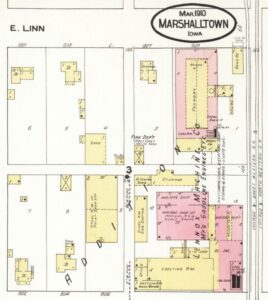
In January of 1910, a reorganization of Lennox Machine Co. was announced, resulting in the transfer of a large amount of stock to men from Chicago (associated with Ryerson & Son). Dave Lennox remained as president, with the three men from Chicago in the other officer roles. Plans were announced to spend $30,000 to $40,000 to improve the plant, updating and bringing in new machinery and equipment, and employment was projected to increase. A further announcement in February discussed plans to enlarge the factory, building a new machine shop to the west of the existing factory.
Labor problems came to Lennox on February 23, when most of the machinists went out on strike. Molders were laid off the next day due to the machinists’ strike. It later came out that workers were unhappy with plans by Lennox to install a bonus system that rewarded more output. A portion of the workers returned and the factory resumed operation in late March.
The labor problems persisted, as strikers threatened employees, and police were stationed at the factory to protect workers. Several skirmishes elsewhere in the city occurred between the strikers and employees. Incidents would continue into 1911, with picketers and non-union men often clashing. Output at the factory was greatly reduced during this time of labor unrest.
Disaster struck on Sunday morning June 25, when a fire destroyed a large portion of the factory. The fire originated in the boiler room, with the cause undetermined, but there were suspicions that it was arson and related to the labor issues. The machine shop and erecting rooms were destroyed, and many patterns were lost. The foundry building, warehouse, and some smaller buildings were saved. Finished stock in the warehouse was also saved, along with some of the larger patterns stored there. There were 60 employees at the time of the fire. Losses were estimated at over $110,000, with insurance coverage much below this amount. The fire was the largest in Marshalltown history up to that time. The factory would lay in ruins for years, and production essentially stopped.
The Lennox Machine Co. filed amended articles of incorporation in early 1912, with control of the company now with Ryerson of Chicago. Dave Lennox began his retirement at age 56.
There were numerous attempts to get production of Lennox engines going again. In July of 1912, it was announced that Lennox would move manufacture of engines to Hampton, Iowa. A new factory was opened as Hampton Foundry & Machine Co., with plans to build eight different sizes of engines. Ads began to appear for the company again in mid-1912, showing the O.K. and Standard engine types.
In early 1913, a new catalog for Lennox engines was published. Listed offerings include Standard engines in 4hp to 30hp sizes, O.K. engines in air-, hopper-, and tank-cooled versions, and also, the vertical C-frame engine. The catalog also made mention of the new two cycle engines just becoming available. Ads became frequent in industry journals, many targeting recruitment of dealers.
Reports are that the new factory in Hampton got off to a good start, making a variety of products for Lennox and others. In 1913, several wanted ads were placed in the newspaper looking for machinists and an expert gasoline engine man. Unfortunately, by November of 1913, the company shut down their shops. Reorganizations followed, but the Hampton company ultimately failed and the building and machinery were sold in November 1914.
Seeing the issues with the Hampton factory, Lennox Machine Co.’s management made the decision to invest in buildings and machinery for the old factory in Marshalltown. Plans called for changing the foundry into a machine shop, and bringing in new machinery, primarily lathes and similar power tools. Yet another blow to the company came in June 1913 when the train carrying the shipment of new equipment was wrecked, and the carload of machinery destroyed, necessitating reordering. But as of July of 1913, the company was busy preparing to manufacture gas engines in large quantities, and had been adding to their Marshalltown workforce.
Only a few ads appeared in 1914, signaling the company was struggling with manufacturing and sales. The end to the factory in Marshalltown for Lennox came in August 1915 with the sale of the property to a furnace maker from Nevada, Iowa. Few, if any, Lennox engines were built after this time. A couple ads for Lennox Machine Co. with Chicago addresses appeared after this, picturing the hopper-cooled engine. The final ad found from February 1918, offers engines from as low as $25, no doubt trying to clear the last ones in stock.
Dave Lennox lived in retirement in his grand house on Nevada Street in Marshalltown. He had a small machine shop at the back of his house where he worked on projects. In his final years, he spent much of his time in his library. Dave Lennox died at 90 years old in 1947. He was considered by many to be the Father of Marshalltown Industry.
Surviving Engines – See You at Mt. Pleasant!
Lennox engines survived in good numbers and are highly sought by collectors today. I’ve documented over 40 survivors over the years, and I’m sure others are tucked away in collections unknown to me. Examples of nearly every style of engine Lennox built are among the survivors, ranging from the smallest two-cycle engines up to a 16hp tank-cooled Standard. We’re hopeful to see many of the unique Lennox engines at the show. See you at the Old Threshers in Mt. Pleasant, Iowa, (September 3-7, 2026) for the legendary Lennox feature!
Barry Tuller is a collector of gas engines and related belt-driven equipment, literature, and advertising. He enjoys learning about engines and researching the history of the people and companies that made them. He can be reached at BTEngines@gmail.com.