

Greensboro, NC 27406
The engine/wagon assembly was restored over a period of 1 years
of part-time effort. The equipment, when obtained, had been sitting
outdoors for approximately 40 years since it was discarded for more
modern machinery. The wagon was badly deteriorated and the engine
was rusty except for areas covered by grease and dirt. The engine
was mounted on this wagon for its working life; however, this
probably was not a factory arrangement.
The wagon has been identified (by one of the ‘experts’
who came by at an engine show) as a J. I. Nissen type which was
manufactured in Winston-Salem, North Carolina. This particular
Nissen wagon is known as a ‘Linch-Pin’ type. A Linch-Pin
wagon is one in which the wheels are assembled by use of pins
through the axles by access of a mortised hole through the wheel
hubs. These wagons were built before the type that has threaded
spindles and nuts to retain the wheels. Using this as a guage, it
is guessed that this particular wagon was manufactured in the late
1800’s or around the turn of the century.
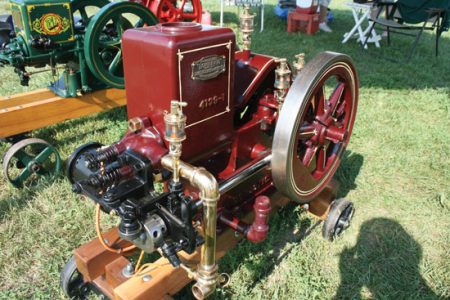
Another engine show ‘expert’ has identified this
Galloway engine as a 1912 manufacture due to certain
characteristics like the shape of the water hopper, the ignitor,
the Lukenheimer carburetor, and a solid brass connecting rod
bearing box similar to the construction used in steam engine
bearing assemblies.
For these reasons it is believed the engine was mounted onto the
wagon for convenience of mobility.
From 1912 until 1930-31 this engine was used in conjunction with
a threshing machine to thresh grain in the Tabernacle Church
Community of Guilford County in North Carolina. In those days,
threshing of grain was accomplished by caravans of volunteer
farmers going from farm to farm to thresh wheat, oats, and barley.
The engine was owned by Mr. John Henry Fields along with the
thresher. Mr. Fields had a large family of boys and all power,
except for the engine, was furnished by mules and horses. My
grandfather, Mr. Sam Bowman, also with a large family of boys and
girls, had teams of horses to furnish for these caravans. Mr.
Fields, Mr. Bowman and their boys would travel from farm to farm to
accomplish the threshing. Mr. Bowman would always furnish an extra
wagon to haul the ‘talley’. In those days money was very
scarce, so payment was made in terms of a ‘talley’ of the
threshed product for payment.
When the caravan would come to a farm, the person receiving the
benefit of the threshing would furnish food for everyone and the
men were allowed to spend the night in the barn on the hay. When
the job was completed the percentage of grain agreed upon (the
‘talley’) was loaded on the ‘talley’ wagon. In
talking with the older folk of the community, these threshing times
were regarded as the good days of farming. People had a chance to
visit together, the women could demonstrate their cooking abilities
and the young men had an opportunity to show off their prize teams
of horses.
Restoration of the Wagon
Negotiations had been in process with Mr. John Henry Fields’
son, Mr. Marvin Fields, for about 6 years to get this rig. Probably
wouldn’t have it yet except for the fact that Mr. Fields became
sick and thought he would not have the strength to restore it
himself. After the initial thrill of obtaining a treasure such as
this and getting it home, you begin to review the situation to see
what is really ahead. The years in the weather had taken their toll
so the only parts that could be salvaged were those made of metal
and three of the four wheel hubs. Everything else was too badly
rotted for use. By observing what had been done approximately 75
years earlier, a new wheel hub was hand-carved from a white-oak
log. This took quite a time since there were rectangular sockets
for the spokes and one side of the socket shape was at an angle to
produce the ‘dish’ in the wheel. Also a large tapered hole
was required in the axial direction to receive the hub sleeve. A
special boring bit, similar to the flat wood bits, was made from
scrap metal and sharpened on a grinder. Using a 1-inch pilot hole
as a guide, this sleeve opening was produced developing lots of
shavings. After reading the chapter in Foxfire Vol.
II on Wagon Construction, the task was begun of hand
forming spokes and felloes. Hand forming means each part is made by
hand using tools such as a bench saw, band saw, jointer, spoke
shave, wood rasp, hand plane, etc. Such special tools as a spoke
puller, a rim puller (used when you shrink the tire) and forming
tools for producing wagon tire bolts were made. All of the wheel
parts were constructed of well-seasoned white-oak and red-oak
material.
By using the original wooden parts as patterns, all other parts
of the wagon were reconstructed using lumber from old buildings
being dismantled. The remainder of the construction was from red
oak, yellow locust, and a tongue constructed from heart pine
(lighter-wood). Just couldn’t pass up the opportunity to make
the brake blocks of solid black-walnut.
The wagon was promptly painted using three coats of red enamel
and trimmed in black. The striping was done using a creme color
paint. All of the paint used is IHC type, right out of the can, and
applied with a brush.
Now with a substantial mounting for the engine and with the help
of a ‘come-along’, some pipe rollers and a pry bar, the
engine was pulled into place on those yellow-locust supports and
bolted solid.
Restoration of the Engine
It was now time to make a survey of the engine. For the most
part the major components were still on the engine. The igniter was
a complete disaster. The casting was solid but all of the other
parts would require remake. The cylinder bore was pretty fair
except for carbon and rust. A turned cylindrical block with
sandpaper fastened to the periphery and powered by a ‘ chuck
electric drill made a dandy hone.
Just a little sideline note about the cylinder. The cylinder
bore is 63/8 inches in diameter
and the HP rating shown on the nameplate is 7. Mr. Marvin Fields
tells that he can remember riding in the wagon beside his father
about 1915 when they transported the cylinder to Greensboro to the
Newman Machine Co. to have the cylinder re-bored and a new piston
fitted. The piston is still good; the ring seats are good and
although there is no knowledge of the changes of piston rings, use
is being made of the ones that were on the piston when restoration
was started.
Most of the bolts and nuts were rusted away or stripped and some
tapped holes were stripped. Some threaded rod, inserts, and new
nuts and washers fixed these areas. The bearings, as might be
expected, were worn but the babbitt was still very good. Some hand
finishing and new cut copper shims solved those problems. New
gaskets were cut from 1/16 thickness asbestos sheet.
The valves were in bad shape but each of the original valves
were salvaged. These valves had cast iron valve heads and were
riveted to a steel valve stem. Sometime during the years of use the
rocker arm had been broken and was replaced by a forged bar made in
a blacksmith’s shop. This part was left as it was found. Just
goes to show that people made the best of what they had in the past
years also.
All of the original brass parts were retained, hand filed,
smoothed, and buffed. Thee included the Lukenheimer carburetor, the
connecting rod, bearing box, and the cylinder oiler. A brass
priming cup and piping, and a brass inlet pipe to the carburetor
were also added.
The original gas tank was constructed in two sections: one for
gasoline for starting and a second for kerosene for running. A new
one-section tank was constructed to hold gasoline only and piped
with copper tubing and brass fittings. To drain the water jacket, a
new brass gate valve was purchased and polished to match the other
brass.
The original seat for this engine wagon was a sack filled with
straw. The straw sack is effective but not very pretty. The spare
parts produced one wagon seat spring, obtained at an estate sale,
and a second was located so the pair made a dandy addition to this
restoration. The buckboard seat along with a foot rest, constructed
from brackets from a discarded electrical distribution tower,
completed the seating arrangement. The doubletree and the
tongue-breast-tree were again purchased at two separate sales.
After applying paint to one’s individual liking, the
restored equipment is ready for display. Now it is true that the
creme color is not the color used by the original manufacturer,
which was probably red, but isn’t the color beautiful on a red
wagon background?
Showtime Arrives
During the 1981 season this restoration was shown in North
Carolina at the Annual Fly-In and Threshers Reunion at Denton and
at the Antique Machinery Show at Silk Hope. The restoration was
also shown at the Blueridge Folk Festival at Ferrum, Virginia, and
the Apple Festival at North Wilkesboro, North Carolina. It is hoped
there will be many happy show days in the seasons to come.
The Beautiful Horses
In regard to this beautiful team of horses, they are owned by
Mr. Calvin Ross of Pleasant Garden, North Carolina. Mr. Ross has a
large dairy operation and uses the horses around the farm. For the
purpose of this picture, Mr. Ross has harnessed his horses with his
finest harness and then added the fly screens to complete the
dressing. The picture was made on a very hot July Saturday
afternoon, year 1981.
About the Wico magneto shown in the photograph: this was
borrowed from a Fuller & Johnson engine as a substitute
ignition system until the ignitor could be rebuilt.
The ignitor has now been completely restored and installed in
its rightful place on the side of the engine. New mica washers,
contact points, a conical spring (lathe-wound from .062 diameter
spring temper wire), and a lot of effort put the old ignitor back
in working order. The rotating arm was thoroughly lubricated using
electrically conductive molybdenum Disulphide paste. This improved
the arcing at the contact points. This ignitor, along with an
ignition coil and a modern-day 12-volt motorcycle, rechargeable,
lead-acid battery, completed the electrical requirements.