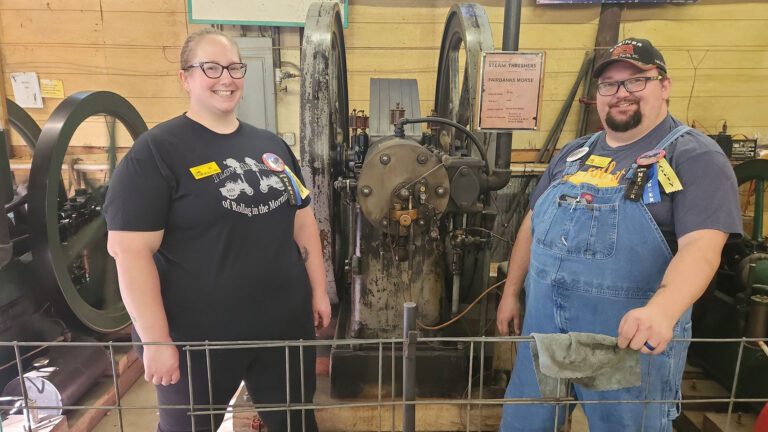
Five generations of Swedbergs have been involved with gasoline engines. The late Jerry Swedberg said, “It all started with Mom, Helen Swedberg. I can remember her pulling out a 1-1/2hp John Deere stationary engine to wash clothes every Monday, and then pulling it back to pump water for the cows the rest of the week. I always wanted an engine, and when I finally got one, I also got the disease. With one engine, you want more.”
According to engine-loving Henry Swedberg of Fargo, North Dakota, his dad had at least 75 gas engines, “Many of them rare and unique ones. He especially liked to collect those that nobody else had, and that changed his collection a lot through the years to get to that point.
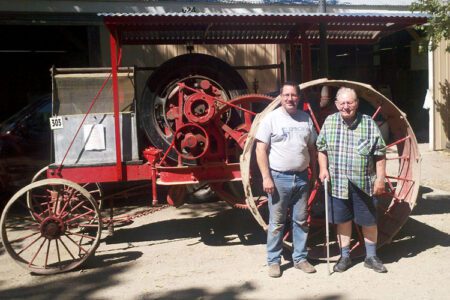
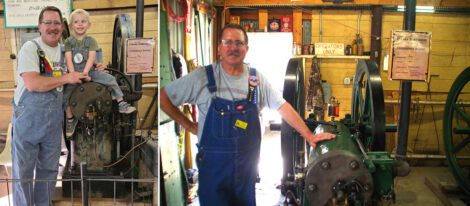
“My dad,” Henry said, “also had two dozen large stationary engines, many fairly rare, and about a dozen hot-air engines. They were used to pump water back in the day, by building a small fire beneath the bottom of the block, and hot air contracting would make the two pistons work. He had a whole bunch of scale model gas engines, and half a dozen tractors. Impossible to get an accurate count of everything he had. But he was an avid collector from the early 1960s until he died in 2018.”
Apple doesn’t fall far from the tree
It’s no surprise that Henry Swedberg would grow up with a love of gasoline engines, though not the desire for a great number of them. “I grew up around engines. We displayed engines at Rollag’s Western Minnesota Steam Thresher’s Reunion every year, and other shows; just the thing my family did. We took many other trips with my father, who’d stop somewhere and say, ‘I heard about this engine here,’ or it could merely be a rumor of some engine.”
Henry’s two brothers and sister were also involved with the gas engine part of life. “Prior to graduating high school, we were all involved. But, as they moved away to both sides of the continent, it kind of slipped away, and their interest in them wasn’t there. But that wasn’t how it went for me.”
Jerry Swedberg was a machinist. “So I ended up working in that machine shop, helping him quite a bit at a pretty early age, cutting parts and carrying steel into the shop. When he needed parts, he made them, but I [mostly] fed the machines. Much to my regret, I didn’t learn to be a machinist. But after my parents divorced, I couldn’t get away from the machinist life fast enough. I thought something in life had to be more fun. So our paths took different directions as I moved around for a few years.”
That included the military. “But after four years, I decided to return to my home area and reconnect with my dad. I figured a good way was through his engine hobby, the one thing he really liked – gasoline engines. And that’s what happened.”
Despite his father’s large gas engine collection, Henry liked his mother’s Handy Andy 1-1/4hp engine the best. “It was a neat size, smaller and easy to handle. When I was a kid, my father gave me a 3hp Economy engine and said, ‘Here, this is for you, so take care of it.’ Other than that, the only engine I ever bought was a 1/8-scale 2hp Stover KA engine made by George Luhrs, a well-known engine maker of New York. It became one of dad’s favorite engines, and that felt good. I liked it because it fit into the palm of my hand, and I bought it in his memory, and he was pretty proud of it, showing it off in a nice wooden box.”
Changes in the collection
As Jerry Swedberg got older, Henry said, “During the last six years of his life, he began selling some of the engines. After he passed away, his wife gave a few away, and sold the majority of the rest of his collection. I was never one to want a lot of engines, but rather the ones I really liked, so dad passed eight Fairbanks-Morse engines to me. They included an 1896 3hp, 1898 4hp pump-jump, 1909 15hp with electric lights flywheels, a 1909 32hp, and 1911hp hopper-cooled.” The other two are listed below.
1905 15hp Fairbanks-Morse
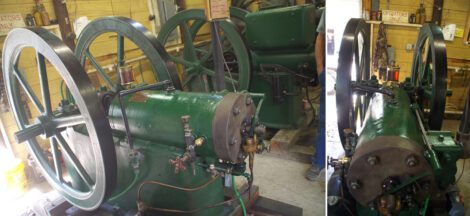
“Dad bought the 1905 15hp Fairbanks-Morse quite a few years ago from a guy named Krieger out of Illinois. I was told that it was red, white, and blue when Dad got it, and he must’ve painted over that. It’s a nice early example of Fairbanks’ industrial engine. Earlier style Fairbanks-Morses like this one are relatively rare, especially some of the first of their productions. Newer ones aren’t. Later, the company made quite a few models, and because of their nature, they’re kind of desirable and collectable, because there aren’t that many around.”
Henry adds that there’s no other Fairbanks N similar to it. “It’s a nice example of an N, and it’s like a lot of them. I enjoy it. It’s very easy to start. When you go to turn it over, and have everything set right, you turn the flywheel twice, and it’ll run all day until it runs out of gas. We use regular old 87 ethanol. We’ve taken care of it and have run it for years.
“I also have a 1/4 or 1/5 scale model similar to that 1905 15hp Fairbanks-Morse.” The 1905 Fairbanks-Morse 15hp has a bore of 8-1/4 inches, stroke of 14-1/2 inches, and a serial no. of 98324.”
1898 3hp Fairbanks-Morse Trip-Igniter engine
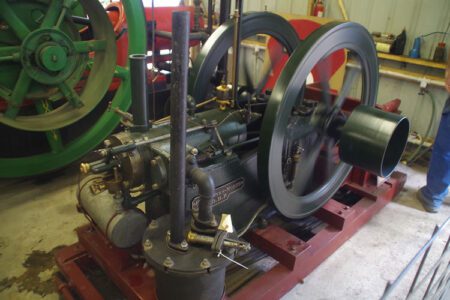
One of the last engines his father bought, Henry said, “was in Rochester, Minnesota, in 2010. That engine is an early example of a Fairbanks-Morse with a piston-trip igniter. Not too many of them around. Dad said only a dozen existed, but I’m not sure how accurate that is. I helped him with that engine a lot.” It has the serial number 3353, with a 5-inch bore and 9-inch stroke.”
Henry added, “In that engine, a stud on the end of the piston comes up and engages the piston, to trip it. Then, to advance or retard the timing, you have to lengthen or shorten the stud on the base of the piston. I did that a number of times. Each time I had to take it apart again, and lengthen the bolt a bit more to get it closer to top dead center in the firing cycle. Each time I reassembled the head and everything to see where it might be firing early or late. After a number of times, I finally got it closer to top dead center in the firing cycle, where it is now.
“When we received that engine, none of that was working. The previous owner had placed a spark plug in the cylinder head to make it fire. We used it like that for a little bit, but eventually I returned it to its original use as a piston-trip igniter. That’s what made the engine rare, unusual, and more authentic. To have a spark plug in a piston-trip igniter kind of defeated the rarity, I thought, so I put it back to the original. Helping my dad get that one back to its original way is one of the things I’ve enjoyed the most. People admire it because it shows early Fairbanks-Morse engine work.”
Henry said, “I did many other restorations with him, always something to make the engines run better. If the fuel pump and the igniter work, it’ll run, though the oilers get leaky sometimes. As with anything mechanical, they always require a little tinkering to make them run. All of them are hit-and-miss governing-style.”
Henry is still asked if he’d like to sell those engines. “Quite a few people have offered me thousands of dollars to sell one of the engines. But I won’t sell them, because they’re a family tradition.”
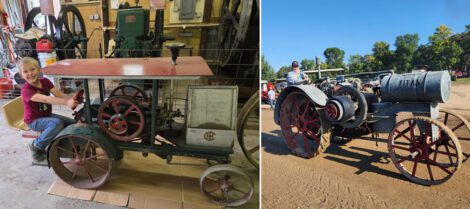
The fourth-generation of the Swedberg gas engine owners is Henry’s daughter, Danielle Swedberg Fennell. Henry said, “She and my grandson Magnus Fennell help me with the engines in the shed at Rollag.
Danielle helps start and clean the engines, adds oil, or adjusts the fuel. She also owns a 1918 Titan International 1020 tractor.”
Danielle said, “For me, working with gas engines and tractors alongside my dad helps me feel connected not only to my family, but to history. I’ve grown up going to Rollag each year and have so many memories of my dad and grandpa. Learning about and preserving the equipment gives me a sense of pride that I’m helping to carry on my grandpa’s legacy. I also really enjoy sharing these pieces of history with other people who can appreciate their craftsmanship and history.”
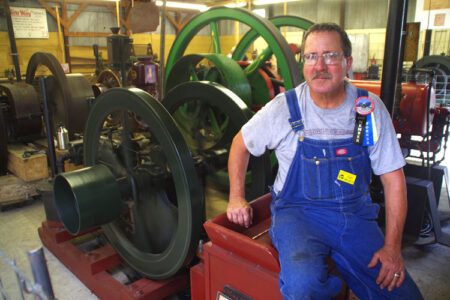
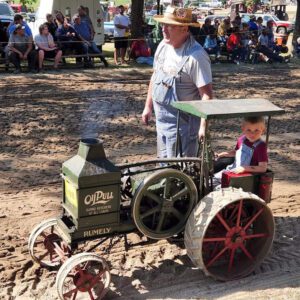
The final cog in the Swedberg engine clan is Danielle’s 7-year-old son Magnus, Henry’s grandson. “Magnus says,” according to Henry, “‘I like going to Rollag because I get to spend time with Grandpa, drive tractors, and eat ice cream. And play at the park.’ He likes to watch the engines run, and he owns a 1hp International starter motor modeled after my 1908 International Model C 20hp tractor. But more than that, he likes to drive those little tractors, like our Model F 1/3-scalemodel Rumely.”
Depending on how a person looks at it, perhaps a sixth generation could be added: Henry’s wife, Anne. “She owns the 1/3-scale Rumely model that Magnus likes so well.”
1/3-Scale Rumely Model
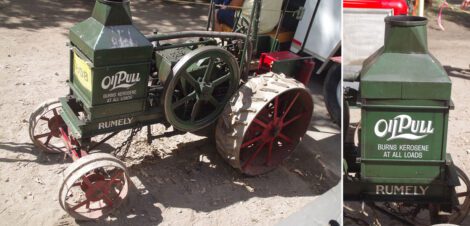
This model is a 1/3-scale Model F single-cylinder Rumely. “It was built in 1956 by Elmer Larson. I have it setting out in front of the building with my gas engines, and everybody admires it quite a bit, and all the kids want to drive it.”
So, Henry obliges them. “With their parents’ permission, I try to get kids actively involved in old iron, and let them drive the Rumely in the daily parade, or just around with adults assisting. Kids are just thrilled; I’ve gotten letters with compliments from parents who said, ‘Driving that tractor was all he could talk about, and it just made his day.'”
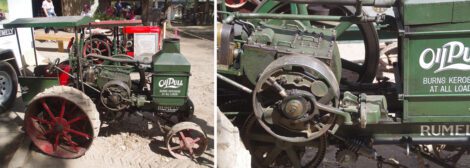
Henry said the model Rumely “is about as accurate as a scale model can be. Instead of a small IH engine, the builder cast the block just like the real engine and installed a baby Rumely engine. Larson said he put 2,000 hours into making the model. He carved scaled-down wood patterns and had the components cast, then machined them, assembled the tractor, and got a running model. All in the 1950s.”
After people saw it, Henry said, “People asked if he had built it, and he said, ‘Yeah, I built it.’ But people didn’t believe him, so he built a 2-cylinder Hart-Parr model and had his name cast into the tops of the cylinders to show that he indeed had built the machine.”
“I’m 63 years old, and I’m not looking for more engines. I just enjoy working on these and showing them at tractor or engine shows within about a five-hour drive.”
He’s never had any close calls with the engines. “I’ve seen it with other people,” he said, “but if you try to show them some respect, and do the safety things, then you’re going to be all right.”
Bill Vossler is a freelance writer and author of several books on antique farm tractors and toys. Contact him at Box 372, 400 Caroline Ln., Rockville, MN 56369; email: wdvossler@outlook.com.