

- Company: Standard Motor Construction Co., Jersey City, N.J.
- Year: 1913-1915
- Serial Number: 29478
- Bore: 4-inch
- Stroke: 5-inch
- Owner: Paul Harvey
Power House Annex: Circa 1913-1915 Standard
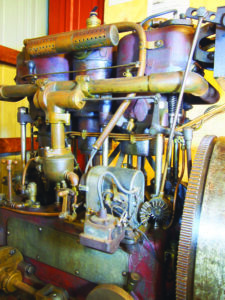
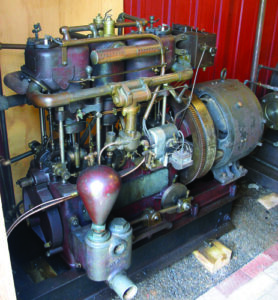
This engine is a Standard auxiliary engine built by the Standard Motor Construction Co. of Jersey City, New Jersey. The Standard was designed by Carl Carlos Riotte when he formed the firm in 1895. He is known for designing the first 4-cycle, 6-cylinder marine engine. His engines were well-designed and balanced to sustain the continuous use they endured.
The engine supplied all of the auxiliary services on World War I submarine chasers; this particular engine served as the source of electrical power, as an air compressor, and as a combined bilge and fire pump. All parts were readily interchangeable so that spares could be carried and the chaser engines easily maintained at sea.
The submarine chasers were a class of wooden vessels that the Navy finally decided to build after German U-boats were spotted in American waters. During that short time, a total of 440 chasers were built. They were 110 feet long and 15 feet beam, and they were armed with one 3-inch gun, depth charges, and two 50-caliber machine guns. The Navy commissioned more than 80 boat builders on the East Coast, the Great Lakes, and the Ohio River to complete this task. And it was successful with the chasers accounting for 40 percent of all German submarine “kills.”
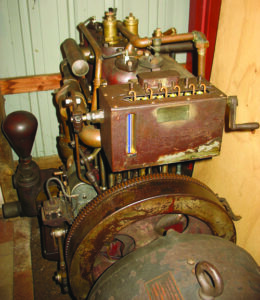
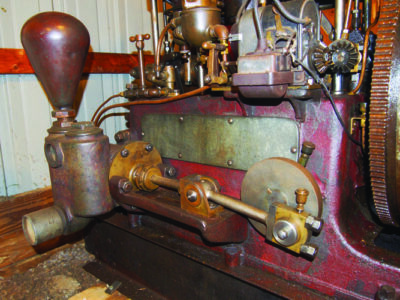
These little vessels, “The Splinter Fleet,” proved seaworthy and plied the waters off Europe, the North Sea, and the Mediterranean Sea. They had the advantage over larger vessels by being able to instantly stop their engines, listen for a sub, then instantly restart or reverse. The larger steam-powered vessels could not shut down all their equipment to be silent. Standard provided all the motive power, supplying three main propulsion engines of 220hp each. These were 6-cylinder, 10-inch bore/11-inch stroke, open crankcase, 4-cycle engines with air starting and air reversing by shifting the cams. Each vessel also had one auxiliary engine like this example.
This company continued being a major manufacturer of marine engines into the 1930s until the Great Depression forced it out of business. This is one of the few Standard engines known to exist.
Originally published as “Coolspring Spotlight” in the June/July 2023 issue of Gas Engine Magazine.